

The Lead Did Not Disappear: Fix Your Lead Management Process

JUXTAPOSED TIDES SMART SERIES
In plain English, a lead is someone who has shown interest in your business. A CRM is software for keeping track of customer conversations, but it cannot take responsibility for the next step unless someone or some carefully defined process actually owns that task.
The Customer Heard From the Website. The Business Never Really Answered.
A prospective customer visits a business website, reviews the services, and fills out a contact form explaining what they need. The form submits successfully and displays a friendly confirmation, while an automatic email assures them that somebody will be in touch shortly. Inside the business, the notification arrives in an inbox and a new record may even appear in the CRM. From a technical perspective, everything looks as though it is working. Three days later, however, the customer hires a competitor, and the people inside the first company describe the inquiry as a lead that went cold.
Perhaps that customer was never going to purchase, but there is another possibility worth examining before drawing that conclusion: the person was ready enough to contact several companies, one company provided a useful response, and the others were still treating the arrival of the form as though that were the accomplishment. The customer did not see the email notification, the CRM activity, or the internal assumption that somebody else would respond. They experienced a question they had asked and an answer they never received. What looked like a lack of customer interest may actually have been a failure of the company's own lead management process.
This is the difference between receiving an inquiry and managing one. A website form can collect information, an autoresponder can acknowledge it, a CRM can store it, and a pipeline can classify it, but none of those things accepts responsibility for the person waiting on the other side. Unless the business can identify a next action, an owner, a reasonable deadline, and evidence that the action occurred, the customer has effectively entered a process with no accountable continuation. The lead has not mysteriously disappeared. Visibility, responsibility, or both have broken down somewhere along the way.
A Lead Is a Person Making a Request, Not a Row in a Database
The word “lead” is useful when discussing marketing and sales, but it can flatten a real person into a statistic. A lead might be a homeowner trying to book a service, a small-business owner needing a website, a customer looking for pricing, or an organization considering a longer engagement. In each case, the person has supplied time, attention, and some measure of trust by initiating contact. That interaction creates a limited but real business obligation to notice the request, understand it, determine whether the business can help, and communicate an appropriate next step.
Meeting that obligation does not mean promising to accept every job or turning every inquiry into a sale. Some requests are outside the service area, beyond current capacity, misaligned with the offer, or simply not ready to proceed. A good process can qualify an opportunity, offer a consultation, request necessary details, refer someone elsewhere, schedule a reasonable follow-up, or close the inquiry respectfully. What makes the process dependable is that the result is deliberate and knowable rather than a guess based on an abandoned email thread.
Think of the lead management process as the path from the first expression of interest to a clear outcome. That outcome may be a customer who begins onboarding, a prospect waiting until a specified time, a person who decides against the service, or an inquiry closed after an appropriate series of attempts to reach them. A business should be able to explain what happened and why. Otherwise, its database becomes a growing collection of names whose true status must be reconstructed whenever somebody wants an answer.
Failure One: The Inquiry Arrives, but Nobody Owns the Arrival
Many businesses believe their incoming leads have an owner because the website sends an email. Yet the destination of that email can be surprisingly vague. Sometimes it lands in the owner's personal inbox among vendor messages, receipts, newsletters, password resets, and routine interruptions. Sometimes it goes to a shared mailbox that everybody can open but nobody is explicitly responsible for watching. Sometimes three people receive it and each assumes one of the others will reply. Even when a dedicated employee usually handles inquiries, a day away from work may leave the entire intake channel unattended.
A dependable lead process starts with a clear intake owner and a designated backup for every meaningful source of inquiries, including website forms, phone calls, referrals, social messages, emails, advertisements, and events. The intake owner's job is not necessarily to conduct every sales conversation. It is to make sure a legitimate inquiry has entered the official record, identify missing information, route the request correctly, and give the next action to a person who understands their responsibility. The backup arrangement matters because an operational system cannot depend on one employee being available every moment the company is open.
This distinction is easy to miss in a busy company: notifying someone is not the same as assigning a responsibility. If a customer submits a form at 9:20 in the morning, the process should make it possible to discover who received the inquiry, whether it was reviewed, who will respond, and what happens if that person cannot act. When that information is unavailable, more notifications will not solve the underlying problem. The process needs ownership, not additional noise.
Failure Two: “We Respond Quickly” Has Never Been Defined
Businesses commonly describe their response time as fast, prompt, or as soon as possible. Those phrases sound reassuring, but they are not operating standards. To one employee, “promptly” means within minutes; to another, it means by the end of the day; to an owner working in the field, it might mean whenever the next quiet moment appears. The customer experiences an actual passage of time while the business experiences a collection of good intentions. When those intentions are never translated into a shared expectation, inconsistency becomes inevitable.
A useful response standard separates receipt from meaningful attention. It specifies when an automated acknowledgment is appropriate, when a human response is required, what first-response window the company can reliably meet during business hours, and how requests arriving at night or over a weekend are handled. It also defines what qualifies as urgent, which communication channels are permitted, and who takes over if the primary owner is unavailable. Most importantly, it tells the customer something truthful about when to expect a response instead of promising “shortly” without having any process capable of honoring that promise.
There is no universal response deadline that fits every service. A time-sensitive repair request, a legal consultation, a custom website proposal, and a months-long strategic engagement involve different risks and buying expectations. The correct standard should account for urgency, the customer's reasonable expectations, the business's staffing, and the decision that actually needs to be made. The point is not to chase an arbitrary number on a stopwatch. It is to turn a vague promise into a realistic rule the team understands and can measure.
Failure Three: The First Reply Creates Activity, Not Progress
A business can technically reply to a lead without making the customer's situation any clearer. Consider a thoughtful inquiry in which a customer explains a specific project and asks whether the company can help. If the reply says, “Thanks for reaching out; how can we help?” the business has made the customer repeat information they already provided. If it says, “Please call us,” it may force the person to abandon the channel they deliberately chose. If the response simply promises that somebody else will be in touch, the customer still does not know who that person is, what they will discuss, or when the conversation should happen.
A strong first human response acknowledges the substance of the request, demonstrates that the details were read, and moves the situation toward a useful decision. Depending on the service, it might confirm that the business serves the customer's location, ask one or two essential questions, explain that a project assessment is needed, offer scheduling options, provide an approximate timeline for a quote, or explain respectfully why the work is outside the company's scope. If there is a genuine delay, the message should identify what the business is waiting for and what the customer can expect next.
This is not a call for robotic sales scripts or overly formal correspondence. Thoughtful, conversational language is part of good service. The operational requirement is that the conversation reduce uncertainty rather than merely record that communication occurred. A friendly message is only useful when it helps the person understand what happens next or why the business needs more information.
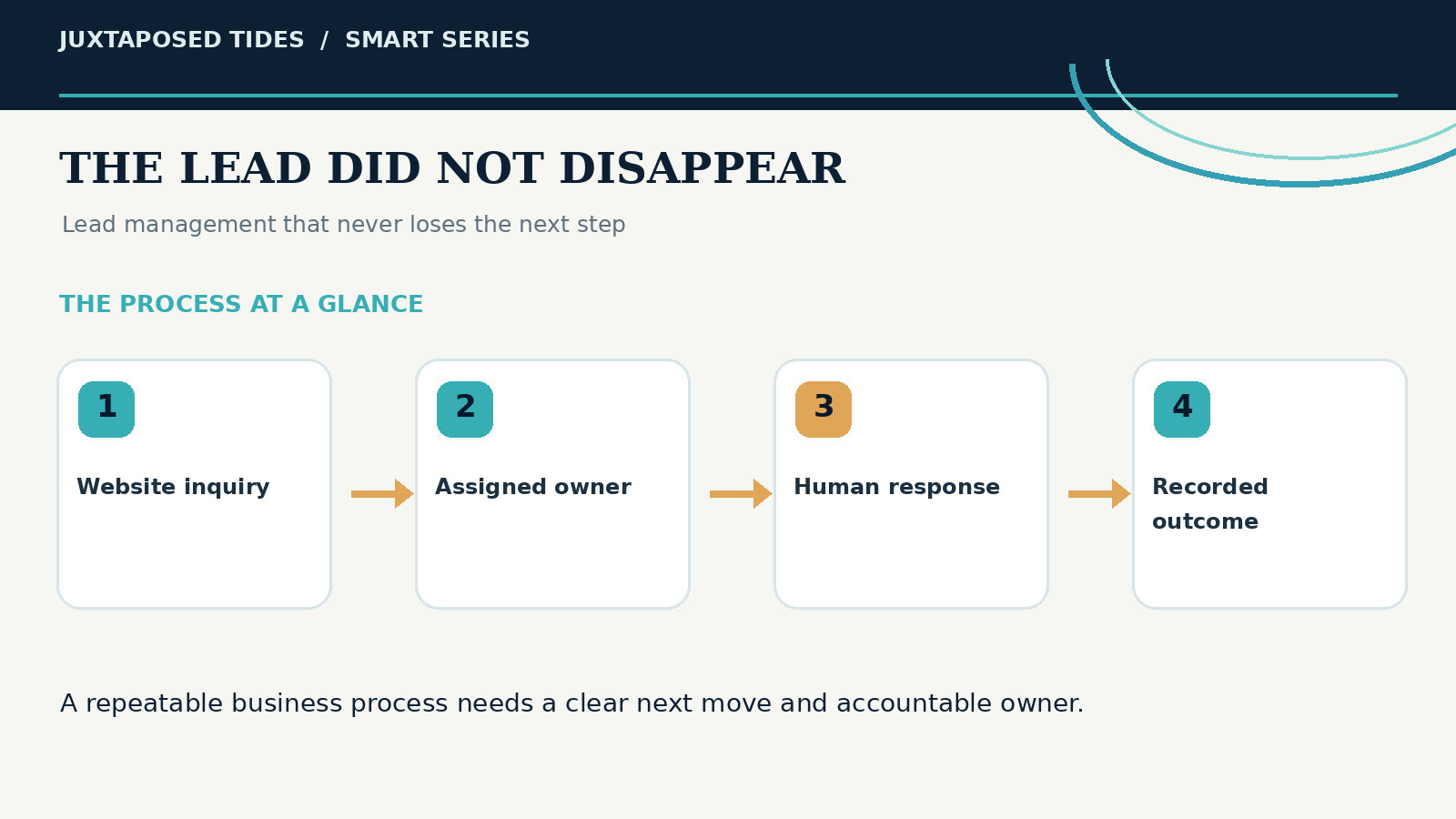
A visual guide to the key stages and responsibilities discussed in this article.
Failure Four: Qualification Depends on Whoever Happens to Answer
When a company has never established consistent qualification rules, employees can make very different decisions about the same inquiry. One person books a consultation for every prospect, while another asks an exhausting series of questions before allowing a conversation. An employee may suggest that the business can take on a job only for the owner to reject it later. Meanwhile, a genuinely promising opportunity may receive an impersonal response because the person handling intake did not recognize its importance. These are often symptoms of an undefined process rather than a lack of effort.
Qualification should determine whether there is a reasonable match between a customer's need and the business's actual offer, timing, availability, service area, capacity, and constraints. Depending on the field, the company might also need to understand budget readiness, project scope, decision authority, required systems, regulatory limitations, or the information necessary to prepare an accurate estimate. The rules should be clear enough for employees to make routine routing decisions consistently while leaving genuinely unusual or consequential situations to the appropriate person.
The amount of information requested should fit the stage of the relationship. Someone asking whether a cleaning service covers their county should not be required to complete a twenty-question application just to receive an answer. A prospect seeking a complex custom platform, on the other hand, may need to describe important business requirements before a provider can offer a meaningful consultation or proposal. Qualification is not about interrogating people. It is about respecting both the customer's time and the company's resources by asking for the right information at the right moment.
A practical qualification framework distinguishes what must be known to route the request, what is necessary before a discovery call, what is necessary before preparing a quote, and what must be confirmed before accepting the work. That prevents the intake process from demanding every detail upfront while also avoiding expensive conversations that could have been redirected by one basic fact. When the reason for declining or referring an inquiry is recorded clearly, the business can learn from its market rather than treating every non-sale as a mystery.
Failure Five: Pipeline Stages Sound Organized but Describe Nothing
A CRM pipeline can look impressively complete while containing stages such as New, Contacted, Working, Interested, Pending, Follow-Up, and Closed. These labels are easy to create and difficult to interpret. Does “Contacted” mean an email was sent, a conversation occurred, or the prospect actually replied? Is a “Working” lead being qualified, quoted, negotiated with, or simply waiting for somebody to find time? What, precisely, is pending when a record sits in a “Pending” column for six weeks? If the label cannot answer a real operational question, it adds decoration rather than clarity.
A meaningful stage describes an observable condition with rules for entry and exit. A newly received inquiry has not yet been reviewed; a reviewed inquiry has the minimum information needed to route it; a customer-information stage means that a specific request has been sent and a follow-up date exists. A qualified lead should have met documented criteria and been offered an appropriate next step. A scheduled discovery call should have an actual confirmed appointment and any necessary preparation instructions. A proposal in preparation should have a company owner and a target date, while a delivered proposal should identify whose decision is outstanding and when the business intends to follow up.
Later stages should distinguish a real pending customer decision from indefinite inactivity, a completed sale that needs onboarding from one that has already been handed off, and different reasons an opportunity did not proceed. “Closed—not a fit” is different from “closed—no response after agreed attempts,” just as “the customer selected another provider” is different from “we could not take the project because capacity was unavailable.” These distinctions can be represented by stages, status fields, or recorded outcome reasons, depending on the size of the system. The objective is not the longest dropdown menu imaginable. The objective is that anyone reviewing the record can understand what has happened, what remains to be done, and who is responsible.
Every active stage should be paired with a next action and either a date or a meaningful trigger. If a lead is waiting for documents, somebody should be responsible for the next appropriate check-in. If the company is preparing a proposal, the assigned person should know the deadline. If the customer is making a decision, the business should respect that customer's timing and document when it may reasonably reconnect. A stage without that operational context is little more than a digital parking space.
Failure Six: “Follow Up Later” Becomes a Permanent State
One of the most common ways a company loses legitimate opportunities is surprisingly ordinary. A customer explains that their budget review will happen next month, or that the work is more likely to move forward after a seasonal rush. An employee writes “follow up” in the CRM or in a personal notebook and returns to the day's immediate responsibilities. The note may contain no date, reason, assigned owner, previous context, or approved next step. When the relevant week arrives, nobody has a reliable reason to see it. Eventually the customer is labeled cold even though the business never acted on the timing it was given.
A responsible follow-up record identifies why the contact should happen, when it is appropriate, who will take the action, which channel makes sense, and what information should be carried forward. It should also specify when to stop, especially when a prospect declines, asks not to be contacted, or has never given permission for ongoing marketing. A customer who says, “Please check back after October 15 when we know our budget,” has provided a meaningful trigger and expectation. Someone who downloads a free checklist has not necessarily invited a campaign of persistent sales messages.
Follow-up is most effective when it matches the relationship rather than treating every record as an opportunity for another automated message. There is a difference between responding to a direct request, providing relevant educational information with appropriate permission, sending necessary transactional updates, and enrolling someone in marketing communications. The process should recognize those distinctions, respect the customer's preferences, and avoid turning persistence into harassment. Reliability is important, but so is restraint.
Failure Seven: Every Handoff Makes the Customer Start Over
The lead's journey often continues through several people: intake, sales, estimating, scheduling, and delivery. If each new person begins by asking, “So, tell me what you're looking for,” the customer soon realizes that the company seems to forget everything it has already been told. The customer may have explained the issue in the form, clarified details by email, discussed priorities during discovery, and approved a written proposal, yet still be asked to repeat the same story when work moves to another employee. That repetition is not merely inconvenient. It communicates that the customer must personally hold the business's memory together.
A successful handoff transfers context and responsibility together. The receiving person should have the original request, important background, customer priorities, agreed constraints, answered questions, promises made, known concerns, qualification results, payment or proposal status where relevant, and a clear next action with ownership and timing. Some facts may still need to be confirmed for accuracy or safety, but the customer should recognize that the business remembers the conversation. The company should not reset to zero whenever a new employee opens the record.
This is especially important when the inquiry becomes a paying customer. The information collected during sales may determine what the delivery team needs to prepare, what was promised, whether a deposit has been collected, which documents are outstanding, and who should send the next update. A “won” label in the sales pipeline is not enough to make that transition happen. The business needs an explicit handoff into onboarding or fulfillment so the relationship does not stall at the very moment the customer has agreed to proceed.
Build a Lead Handoff and Response Map That Reflects Reality
The most useful way to improve this process is to trace a real inquiry from its origin to its final outcome. Start with the source: did the request arrive through the website, a phone call, an advertisement, a referral, a social message, an event, or a partner? Then determine what creates the official record and which system the company treats as authoritative. If the same person appears more than once, the business should know how duplicate records are recognized and handled rather than allowing conflicting versions of the same relationship to circulate.
Capture, Ownership, and Response Expectations
For each lead source, document how the inquiry is captured, who owns intake, and which person provides backup coverage. Identify the exact moment a response obligation begins and how that obligation changes after hours. Record what the customer is told about response timing, what constitutes a human answer, and whether the communication method is appropriate to the request. An online form that promises a reply within one business day should connect to an actual process that makes such a reply reasonably dependable.
Next, define the minimum information required for each decision. Routing an inquiry may require little more than the requested service and location, while scheduling a consultation may require some additional context. A formal quote might require photographs, measurements, existing platform details, or decision-making information. Acceptance may require payment, an agreement, availability, or other confirmed conditions. Separating these needs prevents the business from either asking too much too soon or discovering at the end that the essentials were never collected.
Qualification, Next Actions, and Customer Promises
The map should show the criteria for moving an inquiry forward, the person authorized to approve exceptions, and the next action once that decision is made. That next action should be concrete rather than something vague such as “reach out again.” Examples include sending a list of needed measurements by a specific date, offering a discovery call with defined scheduling options, preparing a quote within an agreed window, or explaining why the service is not a fit. It also matters that the customer has been told what the company will do next, because an internal task with no matching customer expectation still leaves room for confusion.
Each significant step should leave appropriate evidence: a received submission, a documented response, a conversation note, a confirmed meeting, an approved quote, a recorded decision, a scheduled follow-up, or a respectful closure message. Evidence allows another employee to understand the present state without relying on private memory. It also makes it possible for a manager to distinguish a lead genuinely awaiting the customer's decision from one abandoned while the company still owes an answer.
Follow-Up, Closed-Lost Reasons, and Onboarding
When a person is not ready to proceed immediately, document the purpose of future contact, the timing or trigger, the responsible employee, and the point at which the sequence should end. When an opportunity closes without becoming a sale, record a meaningful reason when it is known. Common reasons may include service-area limitations, budget or timing misalignment, a request beyond the current offer, unavailable internal capacity, customer postponement, a choice to work with another company, or no response after an appropriate defined effort. Overusing a generic “other” category leaves the business with little useful information about why opportunities are not advancing.
Finally, describe what must pass from the lead process into onboarding when a sale is made. That handoff may include contact details, service specifications, agreed deliverables, pricing, payment state, signed terms, scheduling requirements, customer preferences, and promises already made. The lead process is complete only when the relationship reaches a clear outcome and, when appropriate, the next business process has accepted responsibility. A closed sale with no operational owner is simply a new version of the same problem.
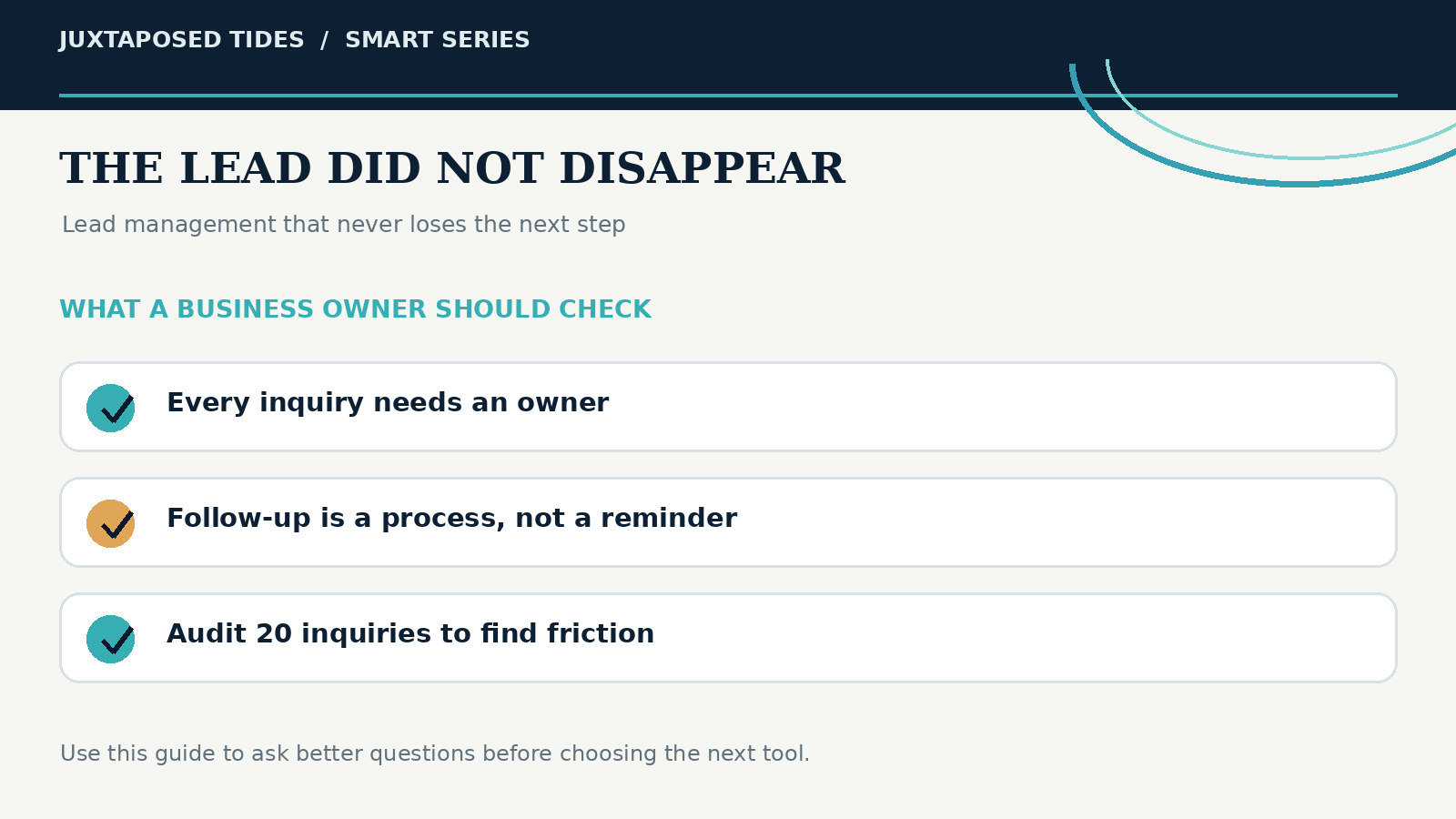
A practical review of the decisions and safeguards that make this process dependable.
Run a Response Audit Before You Buy Another CRM
Before adding software or redesigning the pipeline, take a manageable sample of recent inquiries and reconstruct what actually happened. Twenty inquiries make a practical starting point for many small businesses, although a smaller number may be appropriate for a lower-volume company. Include inquiries from different channels and times, particularly those that arrived outside normal hours. For each one, note when it was received, when an automated acknowledgment went out, when a person first responded, which employee had responsibility, what information was requested, how the opportunity was qualified, which next action was established, and what eventually happened.
Pay particular attention to moments when the next step lacked a clear owner. A record might show an inquiry at 10:00, an internal forward at 11:00, a note saying “someone should call” at 2:00, and no actual response until the following afternoon. That sequence tells a more useful story than a dashboard label reading “contacted.” Record whether the customer had to repeat information, whether a proposed follow-up date was honored, whether the inquiry was truly closed, and why an opportunity ended without a sale when the reason is known.
Once you have reconstructed the sample, look for patterns rather than hunting for a person to blame. Are website inquiries answered more slowly than calls? Do weekend submissions sit unattended? Are proposals sent without a scheduled follow-up? Do particular services repeatedly require information the form never asks for? Are some pipeline stages filled with records waiting on the company while others are genuinely waiting on customers? Does the business close inquiries without sending a clear response? Repeated failures across multiple employees often point to a missing system rule rather than an outbreak of individual carelessness.
The audit should help leadership decide what to change first. If leads arrive reliably but nobody owns the first review, fix ownership. If the first human response is timely but cannot advance the inquiry, improve the qualification information and response approach. If customer context disappears between departments, repair the handoff. It may turn out that the existing tools are perfectly capable of supporting the improved process once somebody defines what that process is supposed to do.
Automate the Defined Process, Not the Confusion
Automation can make a well-understood lead process considerably easier to operate. Software may create a record from a form, send an accurate receipt acknowledgment, assign an intake owner based on service or territory, establish a response deadline, notify the correct employee, schedule an appropriate reminder, flag an overdue action, or generate an internal summary of a conversation. It may also help capture campaign sources and create an onboarding record after the customer accepts an offer. These are valuable uses of technology because each one supports a decision or responsibility that has already been defined.
The danger begins when automation quietly starts making business judgments for which no clear rule exists. A generic workflow should not promise a price the business has never approved, automatically reject an unusual request that needs human consideration, assume customer silence is a final refusal, or enroll somebody in unrelated marketing without an appropriate basis and permission. Qualification involving judgment, special constraints, or material consequences may require review rather than automatic closure. The business should be able to explain why every automated action occurs and what happens when the situation does not fit the normal path.
This is where the Juxtaposed Tides Smart Ops principle becomes useful: understand the real process, repair the weak points, and only then decide what should be automated, configured, integrated, or built. Otherwise, the company may simply teach its software to lose opportunities more consistently, with each failure now neatly timestamped and repeated at scale.
Measure the Moments That Tell You What to Fix
Lead reports can be useful, but a crowded dashboard is not necessarily an informed one. A practical set of measurements might include median first-human-response time, the share of inquiries answered within the company's own standard, time spent in meaningful stages, overdue actions owned by the business, and records with no defined next step. Depending on the service, it may also help to follow qualification rates, scheduled consultations, delivered proposals, win rates by legitimate source, reasons opportunities closed, and the time between a confirmed sale and the start of onboarding. A duplicate-record rate can reveal whether the same customer is being counted several times.
Those numbers only deserve attention when they help answer operational questions. Are we meeting the response promise we made? Where are inquiries waiting, and on whom? Which channels produce opportunities that fit our services? Which stages accumulate stale records? How often do we fail to follow through on actions the company itself owes? Why do qualified opportunities stop moving, and are we actually improving the customer experience rather than merely accelerating messages? A lower response time means little if the reply is confusing, and a higher win rate can be misleading if the company has changed how it classifies inquiries.
Different businesses will use these measures differently. A specialist consultancy handling a small number of substantial projects should not be judged by the same pipeline rhythms as a high-volume service operation. Choose a modest set of trustworthy measurements that reflect the business's buying cycle and capacity, define how each one is calculated, and review the findings often enough to make changes. The purpose of data is to support decisions, not to provide colorful confirmation that the CRM contains numbers.
The Smart Lead Standard: A Process People Can Trust
A lead is being managed responsibly when the original inquiry is reliably captured in a known record, a specific person owns the intake, a realistic response standard applies, and the first reply reduces uncertainty. The process should allow the team to qualify the request consistently, represent its current stage honestly, and identify a next action with an owner and a reasonable deadline. The customer should know what is expected from them and what the business has promised to do. Important context should survive every transfer between people or systems, and follow-up should be deliberate, useful, and respectful.
The process must also have a trustworthy ending. A prospect who declines should be closed as a genuine choice, not treated as a mistake. A customer who needs more time should be recognized as waiting on an understood condition, not abandoned under a permanent “follow-up” label. A person outside the company's service scope deserves an honest answer where practical, and a successful sale should move into onboarding without losing what has been agreed. These outcomes give the business a better view of demand while making its treatment of customers more consistent.
Good employees and persistent customers can rescue weak systems, and some companies continue to sell successfully despite serious gaps. The more useful question is whether the business could repeat the same level of care next week, with a different employee, during a busy season, or after an unexpected disruption. A dependable lead management process makes thoughtful service repeatable without turning it into an impersonal assembly line.
The Final Reality: The Business Must Be Able to Explain What Happened
A lead is not automatically lost because the prospect decides against a purchase. People choose competitors, postpone projects, change priorities, and discover that an offer is not right for them. Those are ordinary business outcomes. A lead is truly lost inside the operation when nobody can explain when the inquiry arrived, what the customer requested, who owned it, what the business said, what action was due next, or why the opportunity stopped. That uncertainty reveals a problem with visibility and accountability more than it reveals a problem with marketing.
The form may have worked, the inbox may have received the message, the CRM may have created a row, and an automated reply may have sounded cheerful and reassuring. None of those events alone proves the company accepted responsibility for the human being on the other side. A strong lead management process closes that gap by connecting each inquiry to a real owner, a meaningful next action, a realistic timeframe, and a recorded outcome. When the business can see that chain clearly, it can stop guessing which opportunities went cold and begin understanding which ones it failed to serve.
Up Next — Part Three: The Handoff Is the System
The next article in The Smart Ops Reality Check examines what happens after work moves from one person, platform, or department to another. Those transitions are where important context disappears, promises change meaning, customers are forced to repeat themselves, and everybody can be technically correct while the experience still fails. Part Three looks at how to design handoffs that preserve both information and responsibility so the business can operate as one connected system.
Further Reading and Original Research
These independent resources are provided so you can explore the evidence and check important recommendations for yourself.
Continue With Juxtaposed Tides


Comments