
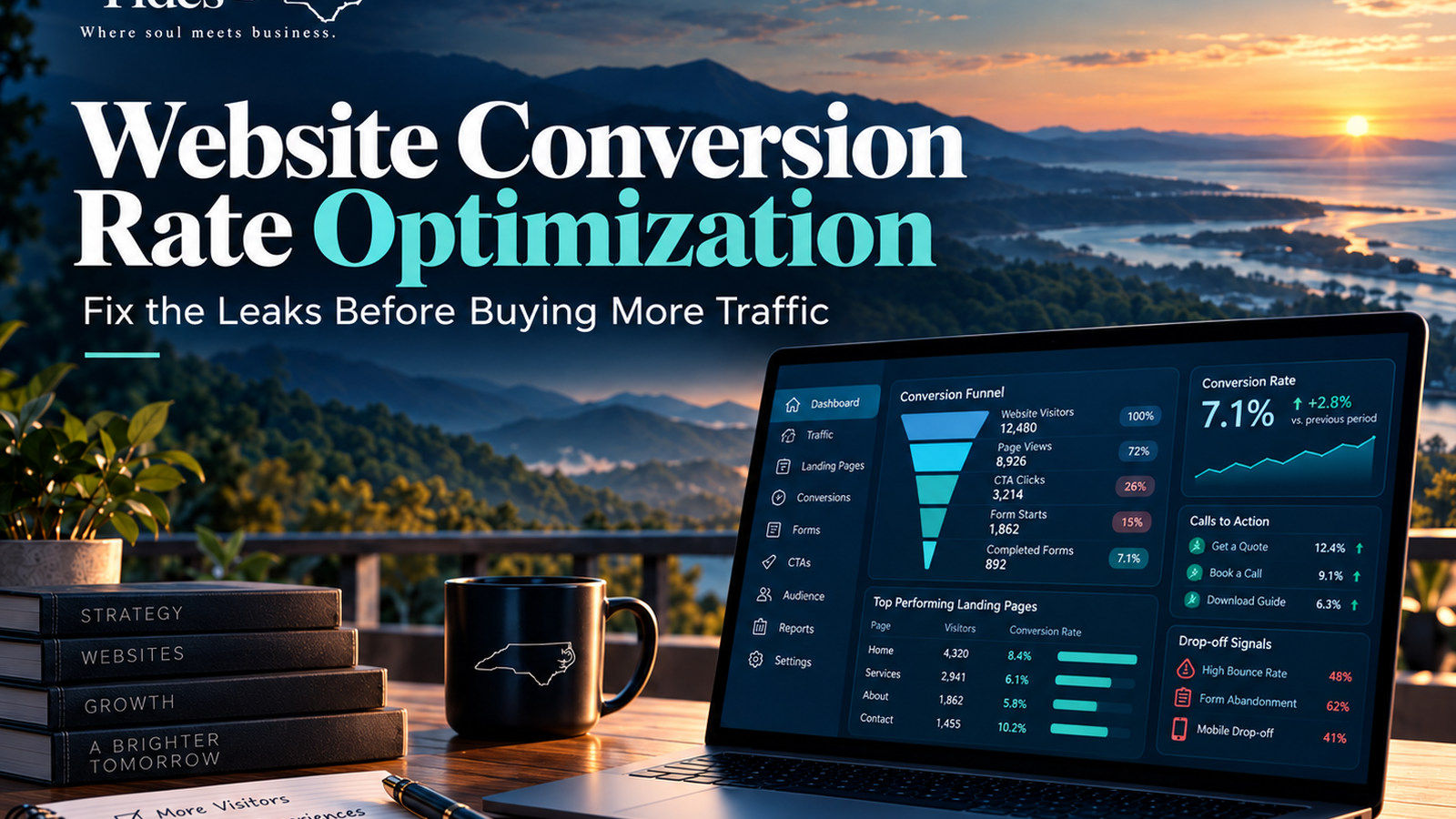
Website Conversion Rate Optimization for Small Business: Fix the Friction

Updated: 4 hours ago
JUXTAPOSED TIDES SMART SERIES
A conversion is simply an action you hoped somebody would take, such as requesting a quote, booking a service, or buying a product. Conversion rate compares successful actions with opportunities to act. The goal is not to turn every visitor into a buyer; it is to make the right next step understandable for people you can actually help.
THE EXPENSIVE MISTAKE: BUYING MORE TRAFFIC FOR A LEAKING WEBSITE
Traffic is easy to see. Conversion friction is harder to see.
When a business owner notices weak lead volume, the instinct is often to increase advertising, post more content, chase another social channel, or invest in SEO. Sometimes that is the right move. But if the website is already losing a large share of qualified visitors because the next step is unclear or unpleasant, more traffic simply feeds more people into the same broken experience.
Think of it this way: if one hundred qualified people arrive and only two take the action you need, doubling the traffic may create four conversions. Improving the experience so five or six of those original one hundred convert can produce a similar or better result without doubling acquisition costs.
That is the point of website conversion rate optimization for small business. It is not about manipulative buttons, fake urgency, or turning every page into a screaming sales pitch. It is about removing unnecessary resistance between a visitor’s intention and the business outcome both sides actually want.
WHAT COUNTS AS A CONVERSION? A conversion is any meaningful action that moves the visitor forward. The correct action depends on the business model.
For a local service business, a conversion may be a quote request, phone call, booking, or completed intake form. For a consultant, it may be a discovery-call request, lead-magnet download, or proposal inquiry. For ecommerce, the obvious conversion is a purchase, but adding to cart, starting checkout, creating an account, or joining a back-in-stock list can also reveal whether the journey is working.
The first optimization mistake is measuring only the final sale. Most customer journeys contain several micro-conversions. If you track only revenue, you know that something failed but not where it failed. Map the path in stages: 1. Arrival — the visitor lands on the site. 2. Orientation — they understand what the business does and whether it applies to them. 3. Confidence — they find enough evidence to believe the business can solve the problem.
4. Decision — they choose an offer, product, service, or next step. 5. Action — they submit, book, call, buy, subscribe, or request. 6. Confirmation — they understand what happens next. A conversion strategy becomes far more useful when you can see which stage is leaking.
THE FIVE FRICTION LEAKS THAT COST SMALL BUSINESSES THE MOST
Leak 1: Message friction. Visitors should not have to decode the business. A homepage can be beautifully designed and still fail because it never answers three basic questions fast enough: What do you do? Who is it for? What should I do next? Vague headlines, internal jargon, oversized mission statements, and generic claims like “solutions for your success” create cognitive work. Every extra moment of interpretation gives the visitor another chance to leave.
The strongest opening message usually combines audience, problem, outcome, and next step. It does not need to say everything. It needs to make the right person feel oriented. Leak 2: Navigation friction. The website may offer too many routes, hide the important route, or change the route from page to page. Every primary page should have a dominant next action. Secondary paths can exist, but they should not compete equally with the main business objective.
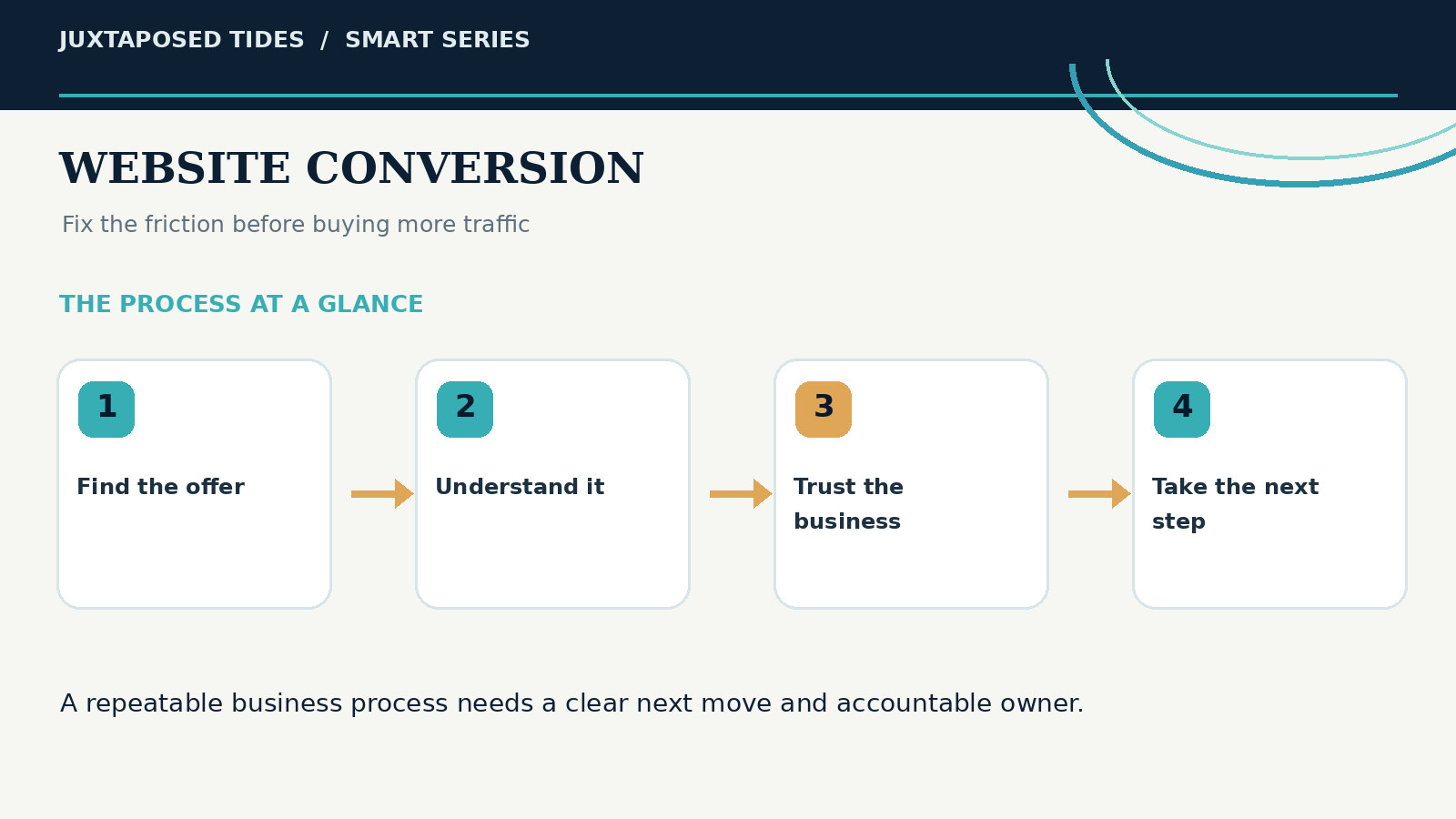
A visual guide to the key stages and responsibilities discussed in this article.
A service page that offers “Learn More,” “Explore,” “View Our Work,” “Contact,” “See Pricing,” “Read the Blog,” and “Book Now” with identical visual weight is not giving the visitor freedom. It is transferring the burden of strategy to the visitor. Leak 3: Trust friction.
People hesitate when the cost of being wrong feels high. They look for evidence: real business information, recent reviews, clear pricing context, policies, credentials, examples, process explanations, contact details, secure payment indicators, and signs that an actual organization stands behind the site.
Trust should appear before the visitor reaches the final decision point, not only on an About page buried in the footer. Leak 4: Interaction friction.
Long forms, tiny mobile controls, hidden fees, confusing calendars, forced account creation, unclear validation errors, and unnecessary fields create mechanical resistance. These are especially damaging because the visitor may already be convinced. The business loses the conversion not because the offer was weak, but because completing the action became annoying.
The W3C’s updated forms guidance specifically recommends simple, short forms and notes that irrelevant or excessive information increases the likelihood of abandonment. Accessible labels and clear instructions also help users complete forms successfully. Leak 5: Technical friction. A conversion journey can fail before the copy gets a chance. Slow loading, unstable layouts, broken buttons, scripts that fail, pop-ups that block the screen, mobile elements that overlap, or confirmation pages that never appear all introduce technical doubt.
Google’s current Core Web Vitals guidance focuses on loading performance, responsiveness, and visual stability. Its recommended “good” thresholds include Largest Contentful Paint within 2.5 seconds, Interaction to Next Paint below 200 milliseconds, and Cumulative Layout Shift below 0.1. Those metrics are not a substitute for good strategy, but poor performance can absolutely make a strong offer harder to buy.
START WITH THE HIGHEST-INTENT PAGES
Do not begin conversion optimization by redesigning the entire website. Start where the money and decisions happen. For most small businesses, that means the homepage, top service pages, product pages, pricing page, booking page, contact or quote form, cart, checkout, and any major campaign landing pages. For each page, answer: What visitor arrives here? What do they probably already know? What are they trying to decide?
What concern could stop them? What is the single most valuable next action? What proof should appear before that action? What information can be removed or moved later? This is where the JT Smart Series principle of building journeys instead of disconnected pages becomes useful. A page does not convert in isolation. It converts because the page before it prepared the visitor and the page after it completes the promise.
Read the Juxtaposed Tides Build Smart overview for the broader systems approach:
THE 60-MINUTE FRICTION AUDIT
A small business can uncover major problems without expensive testing software. Run this audit on both desktop and a real phone. First 10 minutes: orientation. Open the homepage as if you have never seen the business. Within a few seconds, can you identify the customer, offer, location or service area when relevant, and the main next step? If not, mark the opening section. Next 10 minutes: navigation. Try to reach the top three revenue-producing actions. Count taps or clicks. Note dead ends, duplicate paths, vague labels, and pages where the primary call to action disappears.
Next 10 minutes: trust. Look for specific proof near high-intent decisions. Are testimonials believable and attributable? Are reviews current? Are policies easy to find? Is pricing explained enough to reduce surprise? Is the company reachable? Next 10 minutes: forms and booking. Complete every important form. Test validation. Use the phone keyboard. Check whether fields are truly necessary. Confirm that the success message clearly explains the next step.
Next 10 minutes: performance. Test key pages using Search Console or PageSpeed tools and pay attention to Core Web Vitals. Do not obsess over a perfect laboratory score. Focus on real problems that users can feel. Final 10 minutes: measurement.
Confirm that important actions are tracked. Google Analytics allows businesses to mark important events as key events, then report on how often users perform them and which channels contributed to those actions. If the site has no meaningful event measurement, optimization becomes guesswork.
MEASURE THE FUNNEL, NOT JUST THE FINAL NUMBER
A conversion rate alone can mislead you.
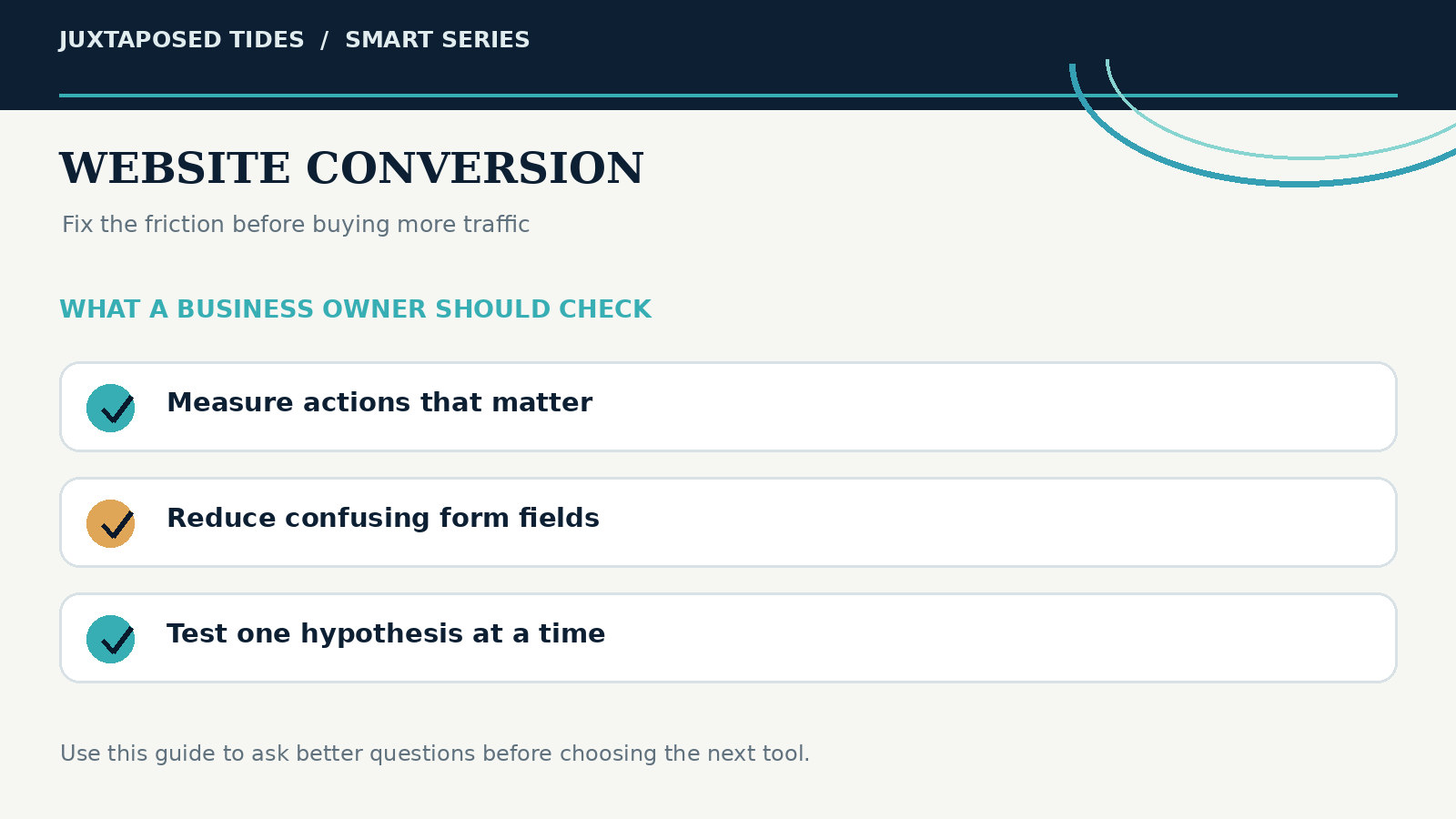
A practical review of the decisions and safeguards that make this process dependable.
Suppose a booking page converts poorly. The problem could be the booking page. But it could also be that unqualified visitors are reaching it from vague calls to action. Or the page could be strong while the calendar has no convenient availability. Or the form may convert well on desktop but fail on mobile.
Use a simple funnel report: Visitors to high-intent page → Call-to-action clicks → Form or booking starts → Form or booking completions → Qualified leads → Sales or completed transactions Now the business can ask a much better question: Where is the largest meaningful drop? That is where the next test belongs.
TEST ONE REAL QUESTION AT A TIME
Small businesses rarely have enough traffic to support endless A/B testing. That is fine. You can still optimize intelligently. Make changes around a clear hypothesis. For example: “Visitors are abandoning the quote page because they do not understand what happens after submission.” Then improve the explanation next to the form and compare completion quality over a reasonable period. Or: “Mobile users cannot quickly find the booking action.”
Then make the mobile call to action persistent or more prominent and measure booking starts. The goal is not to endlessly redesign. The goal is to identify friction, make one meaningful improvement, measure the result, and keep the change only when it strengthens the journey.
DO NOT OPTIMIZE YOUR WAY INTO A DARK PATTERN
There is a bad version of conversion optimization: fake countdown timers, hidden cancellation paths, preselected add-ons, misleading buttons, manufactured reviews, or aggressive pop-ups that trap the visitor.
Those tactics can create short-term numbers while damaging trust and introducing legal or platform risk. The FTC’s Consumer Reviews and Testimonials Rule addresses deceptive conduct involving fake reviews and testimonials, including buying reviews conditioned on a particular sentiment. Trust is not a decoration. It is part of conversion infrastructure.
The better approach is to make the decision easier, not less informed.
THE JT CONVERSION PRIORITY SCORE
Before fixing a problem, score it from one to five on four dimensions: Impact — How many qualified visitors encounter it? Intent — How close are those visitors to an important action? Severity — How badly does the issue block or confuse them? Effort — How difficult is the fix? High-impact, high-intent, high-severity, low-effort problems should move first. A broken booking button deserves attention before a minor font choice. A twelve-field quote form deserves attention before a decorative homepage animation. A slow product page deserves attention before a new blog category.
FIX THE LEAK BEFORE YOU TURN UP THE FAUCET
Website conversion rate optimization for small business is ultimately a discipline of respect. Respect the visitor’s time. Respect their uncertainty. Respect mobile constraints. Respect the fact that buying, booking, or contacting a company always carries some amount of risk.
More traffic can grow a strong system. It can also magnify a weak one. Before spending the next dollar to bring more people to the website, make sure the people already arriving can understand the offer, trust the business, complete the next step, and receive a clear confirmation afterward. That is when traffic becomes leverage instead of leakage.
Further Reading and Original Research
These independent resources are provided so you can explore the evidence and check important recommendations for yourself.
Continue With Juxtaposed Tides
Continue learning: practical next steps
JT Factory public reading path: This is a free educational article. The complete 24-lesson JT Agentic Business Factory curriculum and member implementation kits are separate paid resources. Explore the course to see whether its supervised workflow approach is right for you.
Interested in going from ideas to a supervised workflow? Explore the JT Agentic Business Factory course, covering AI agents, connected tools, real evidence, human approval and practical business pilots.
Before enrolling, review the course options and included access.
Two practical guides from JT Publishing Co.: The StarNet Technical Field Manual focuses on agents, setup and workflows; The One-Person Empire explores the business side of operating with AI support. Standalone books are separate from course membership.
For a service or tool instead of a course, see JT Smart Tools.
Read next in our free article library: Your Business Already Has an Operating System: Why Every Company Has Workflows—Even When Nobody Designed Them.
For independent, reader-first guidance on discoverability and site content, see Google Search Central's SEO Starter Guide. This external resource is for independent learning, not an endorsement of JT.
Want help turning these conversion principles into practical improvements on your own site? Explore our website design, optimization, and ongoing support services, or schedule a free website strategy consultation to identify the next useful step.


Comments