

Payment Fraud Prevention for Small Business: Protect Every Money Path

JUXTAPOSED TIDES SMART SERIES
A chargeback happens when a cardholder disputes a payment through their card provider. It is different from a refund your business approves directly. Both situations require clear records, customer communication, and careful use of the payment provider's procedures.
Payment Security Is Larger Than Checkout
Small businesses often think payment security means adding a lock icon to the website. The real system is broader. Customers pay through checkout, invoices, recurring subscriptions, booking deposits, mobile terminals, bank transfers, peer-to-peer services, or in-person devices. The business also sends refunds, pays vendors, changes payroll, and creates new beneficiaries. Fraud can enter or exit through any of those paths.
Payment fraud prevention for small business requires two views at once: protect customer payment data and protect the company’s authority to move money. PCI security guidance focuses on safe handling of cardholder data. FBI and FTC guidance highlights impersonation, fake invoices, and changed payment instructions. The strongest program connects both.
Reduce the Amount of Payment Data You Handle
Use reputable payment processors and hosted payment components that keep card data out of your website and internal systems whenever possible. Do not collect card numbers through email, chat, generic forms, spreadsheets, or notes. Do not store security codes. Limit who can access payment dashboards, transaction exports, and customer billing information.
PCI DSS applies to entities involved in payment processing regardless of size, although validation requirements vary. Small merchants should work with their acquiring bank and payment provider to understand responsibilities. Choosing a managed payment path can reduce—but not eliminate—the business’s security obligations.
Secure Checkout and Account Access
Protect payment and ecommerce administrator accounts with MFA, individual users, and role-based permissions. Review apps, API keys, webhooks, and integrations. Turn on alerts for new administrators, payout-account changes, refunds, disputes, unusual transaction volume, and failed-login patterns.
Keep ecommerce software, plugins, and devices updated. Use supported terminals and secure remote access. Avoid default passwords. Separate development and live credentials. Test checkout after changes to ensure the customer is not redirected to an unexpected domain or script.
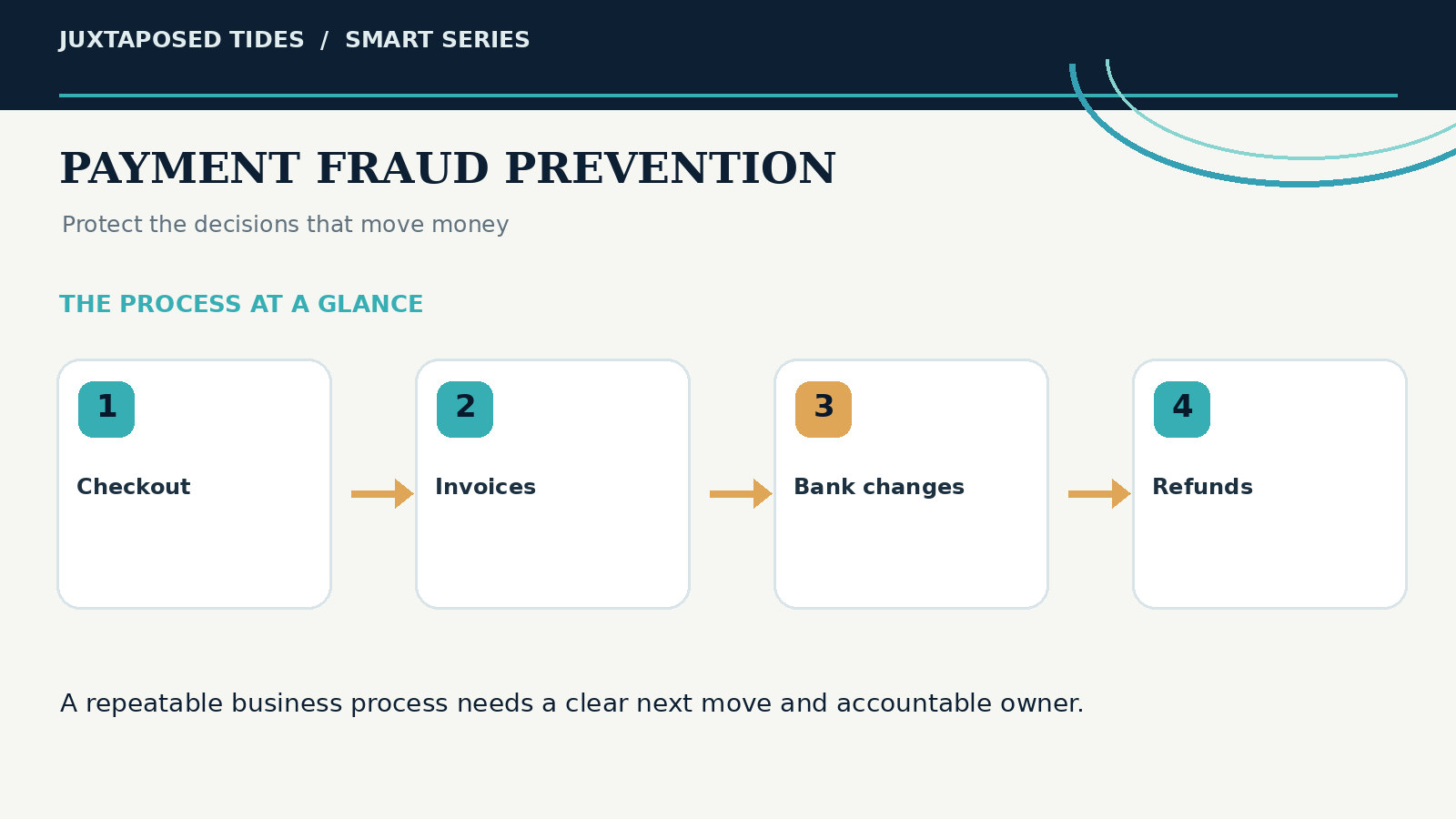
A visual guide to the key stages and responsibilities discussed in this article.
Prevent Invoice and Vendor Payment Fraud
A realistic invoice may be fraudulent even when the document is perfect. Require independent verification for: New vendor bank accounts Changes to routing or account numbers Requests to use a different payment method Urgent or duplicate invoices Unusual payment destinations Changes in remittance address Call a known contact using information already on file. Confirm the exact change and document who verified it. Separate vendor setup, invoice approval, and payment release when staffing allows. Use dollar thresholds and dual approval for high-risk transfers.
Design Refund Controls
Refunds are a customer-service function and a money-movement function. Limit who can issue them. Require refunds to return to the original payment method unless an approved exception exists. Review large, repeated, manual, or out-of-window refunds. Document the reason and related order or service record.
Protect support accounts because attackers may take over a customer profile, impersonate a buyer, or pressure an agent into redirecting funds. Build identity verification and escalation for unusual requests.
Manage Chargebacks With Evidence and Clarity
Chargebacks can result from fraud, confusion, poor communication, delivery failures, or customers not recognizing the billing descriptor. Reduce preventable disputes through clear product descriptions, pricing, renewal terms, cancellation paths, delivery records, receipts, support contact information, and recognizable statement descriptors.
Maintain organized evidence: order details, timestamps, IP or device information where appropriately collected, customer communication, proof of delivery, service logs, refund history, and policy acceptance. Do not fabricate or overstate evidence. The goal is a fair, documented record.
Protect Recurring Payments and Subscriptions
Explain billing frequency, trial conversion, renewal timing, cancellation, and refund terms before purchase. Send confirmations and renewal notices where appropriate. Make cancellation reasonably accessible. Deceptive friction may increase short-term retention while increasing disputes, complaints, and regulatory risk.
Limit access to subscription settings, discounts, coupons, and plan changes. Monitor unusual account creation, coupon abuse, card testing, and repeated payment failures.
Secure Payout and Banking Changes
A compromised payment platform can be used to redirect payouts even when checkout remains normal. Require MFA, restricted administrator roles, and independent verification for payout-account changes. Turn on bank and processor alerts. Review settlement reports and reconcile deposits to transactions.
Do not let a single email, text, or voice call authorize a new destination. Apply the verification protocol from the AI impersonation article. The bank account itself should have transaction limits, alerts, and separation between viewing, initiating, and approving when available.
Fast action matters: If a fraudulent transfer occurs, contact the financial institution immediately. Do not wait until every internal detail is known.
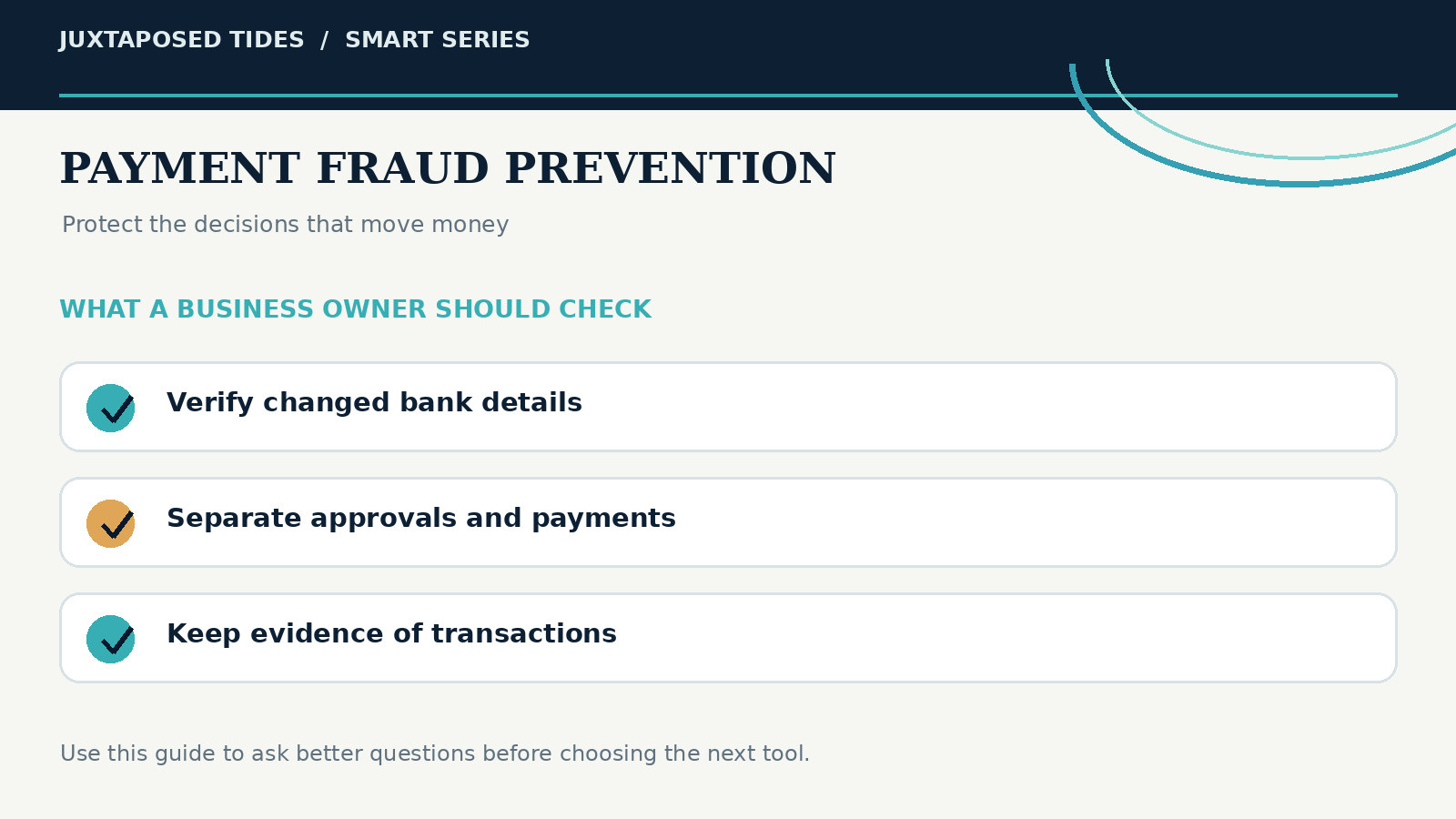
A practical review of the decisions and safeguards that make this process dependable.
Use a Payment Risk Register
List each money path and assign controls. Customer checkout: processor, hosted fields, fraud settings, alerts, owner Invoices: creation, delivery, bank-change verification, approval Refunds: permissions, thresholds, original-method rule, review Subscriptions: disclosure, renewal, cancellation, monitoring Vendor payments: onboarding, bank verification, dual approval Payroll: change verification, access, approval, audit
Payouts: account-change controls, reconciliation, alerts
This register makes gaps visible and helps the business evaluate tools. The cheapest platform may become expensive if it lacks roles, logs, exportable records, reliable integrations, or fraud controls. See the 2026 Website Cost Guide and Choosing the Right Website Platform for Your Business.
A Payment Fraud Prevention Checklist
Use a reputable, PCI-aligned payment provider. Keep card data out of email, forms, spreadsheets, and internal notes. Enable MFA and individual accounts for processors, banks, ecommerce, and accounting. Restrict refunds, discounts, payout changes, and payment exports. Verify vendor bank changes through a known channel. Require dual approval above defined thresholds. Turn on transaction, refund, payout, and account-change alerts.
Reconcile deposits, refunds, fees, and disputes. Publish clear pricing, billing, cancellation, and refund terms. Maintain a rapid fraud-response contact list for banks, processors, hosting, email, and law enforcement reporting.
Secure the Decision That Moves the Money
Fraud tools and processor settings are useful, but the most important control is the business process surrounding authority. Who may create a payee? Who may change an account? Who may approve a refund? What must be verified? What evidence is retained? What happens when a request is urgent?
Protecting money means securing checkout and securing judgment. Build both into the platform from the start.
Further Reading and Original Research
These independent resources are provided so you can explore the evidence and check important recommendations for yourself.
Continue With Juxtaposed Tides


Comments