
The Handoff Is the System: A Business Handoff Process That Works

Updated: 2 days ago

JUXTAPOSED TIDES SMART SERIES
A handoff is the moment one person or system finishes its part and another takes over. If the next owner never receives the customer's history, the promise already made, and the task that comes next, the business has moved activity without actually moving responsibility.
THE HANDOFF IS THE SYSTEM
Why Customers Experience the Gaps Between Your People, Platforms, and Departments Sales closed the deal. The agreement was signed. The payment was processed. The salesperson celebrated, moved the opportunity to “won,” and began working the next lead. Operations received a notification that a new customer existed.
What operations did not receive was the exception the salesperson approved, the date the customer believed work would begin, the custom deliverable mentioned during the call, the reason the customer was anxious, or the promise that “someone will walk you through everything personally.”
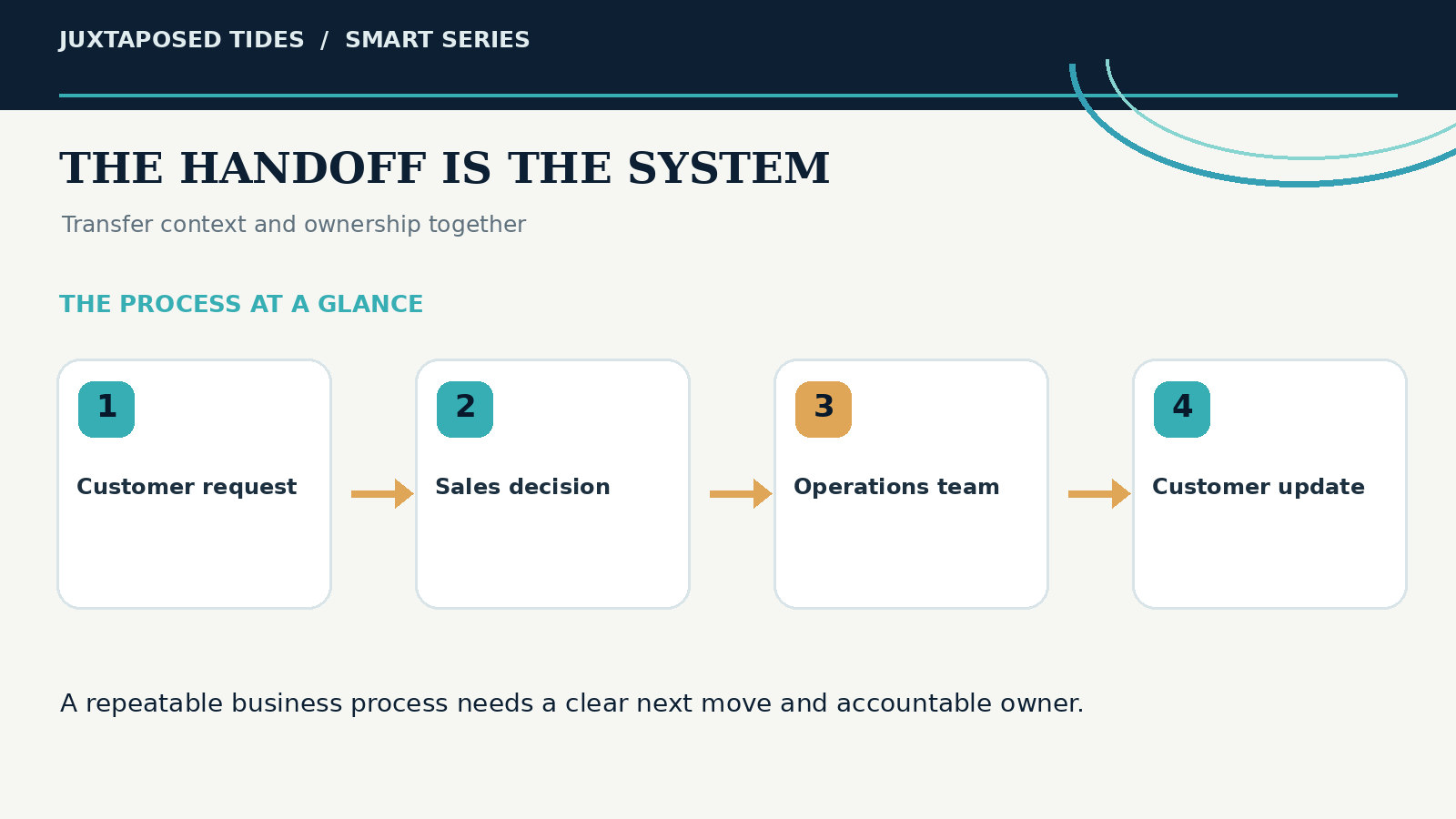
Operations sent the standard onboarding email. The customer replied: “I thought we already discussed this.” Sales believed the job was complete because the deal closed. Operations believed the job began with the record it received. The customer believed they were working with one company. The customer was correct. The customer does not experience your departments. The customer experiences every place your departments fail to meet.
The Work Between the Work Businesses often document individual tasks. Complete the discovery call. Prepare the quote. Send the invoice. Create the project. Schedule the service. Deliver the work. Close the ticket. Those tasks may be performed correctly and the overall experience may still fail. The failure lives between them. A handoff is the transfer of responsibility, context, information, authority, timing, and evidence from one person, role, team, or system to another.
It is not merely sending an email. It is not moving a card. It is not changing a status. It is not mentioning something during a meeting. It is not placing a document in a shared folder and hoping the next person develops an unexplained spiritual connection to it. A handoff is complete only when the receiving party has what they need, knows what they own, understands what has been promised, and can continue without reconstructing the previous stage.
Every Handoff Contains a Contract A reliable handoff contains an internal contract, even when no formal contract exists. The sending side agrees to provide: The correct work The required information The relevant history The current status Known risks and exceptions Promises already made The requested timing Evidence of prior completion The decision or approval that authorizes the next step The receiving side agrees to:
Confirm receipt Review completeness Accept ownership Identify missing information Begin within the expected time Communicate exceptions Preserve the customer context Create evidence of the next stage When these expectations are unstated, each side invents its own definition of “handoff complete.” The sender thinks, “I sent it.” The receiver thinks, “I have not reviewed it.” The customer thinks, “Why is nothing happening?”
Sending Is Not Receiving One of the most common operational mistakes is treating transmission as completion. An email was sent. A task was assigned. A notification fired. A file was uploaded. A chat message was posted. A meeting note was shared. None of those actions proves the receiving person noticed, understood, accepted, or acted. A high-consequence handoff needs an acknowledgment mechanism. That may be:
A status change A task acceptance A required review checkbox A timestamp A reply A queue assignment A dashboard showing unaccepted work A meeting confirmation An automated alert when acceptance does not occur The acknowledgment should match the risk. A low-risk internal content request may not need ceremony. A patient referral, payment exception, legal deadline, project launch, or customer promise deserves more than “I tagged you in the thread.”
The Context Package A handoff should transfer a context package rather than a pile of disconnected information. A useful context package includes:
1. IDENTITY
Who or what is this about? Customer, project, order, case, application, ticket, invoice, shipment, or another record?
2. PURPOSE
Why is the work moving now? What stage was completed, and what stage begins?
3. CURRENT STATUS
What is true at this moment? Avoid vague labels. Describe the actual condition.
4. CUSTOMER OBJECTIVE
What is the customer trying to accomplish? What matters most to them?
5. BUSINESS COMMITMENT
What has the company promised? Include scope, timing, pricing, communication, accommodations, and exceptions.
6. DECISIONS MADE
Which choices were approved? Who approved them?
A visual guide to the key stages and responsibilities discussed in this article.
7. INFORMATION COLLECTED
What facts are known? Where is the source of truth?
8. OPEN QUESTIONS
What remains unresolved? Who owns obtaining the answer?
9. RISKS AND EXCEPTIONS
What could complicate the next stage? What is unusual?
10. NEXT ACTION
What must the receiver do? By when?
11. COMPLETION EVIDENCE
What proves the sender’s stage is complete?
12. CUSTOMER EXPECTATION
What does the customer believe will happen next, and when? This is not about writing a novel for every transfer. It is about transferring the minimum complete context required to continue safely. The Minimum Complete Handoff A handoff can fail by being too thin. “New client. Please onboard.” It can also fail by being too large. “Everything is somewhere in this 137-message thread.” The goal is minimum complete context.
Minimum means no unnecessary archaeology. Complete means the receiving person does not have to guess at material facts. A useful test is: Could a competent person who was not present in the previous stage continue the work without asking the customer to rebuild the company’s memory? If not, the handoff is incomplete. The Customer Should Not Be the Integration When internal systems do not share information, the customer often becomes the integration layer.
They repeat their address. They resend the document. They explain the problem again. They remind support what sales promised. They tell billing that the project was canceled. They notify delivery that the date changed. They call one department to explain what another department already knows. The customer is effectively copying and pasting data between the company’s people and systems. That is not a premium human touch.
That is unpaid administrative labor assigned to the person who is already paying the business. Some repetition is appropriate for confirmation, security, or changed circumstances. Repeated reconstruction is a design failure. Where Handoffs Commonly Break
SALES TO DELIVERY
Promises, exceptions, priorities, and customer expectations fail to transfer.
MARKETING TO SALES
The lead source, campaign promise, content consumed, or stated need is missing, so sales begins with a generic conversation.
SALES TO FINANCE
Pricing exceptions, deposit terms, billing contacts, purchase-order requirements, and renewal conditions are unclear.
PAYMENT TO ACCESS
Payment succeeds, but account creation, product access, booking, or fulfillment does not begin.
ONBOARDING TO DELIVERY
Documents were collected but not reviewed. The project starts with hidden gaps.
DELIVERY TO SUPPORT
Support receives the problem but not the implementation history, limitations, configuration, or known workarounds.
SUPPORT TO PRODUCT OR OPERATIONS
Recurring customer problems remain isolated tickets rather than becoming evidence for system improvement.
EMPLOYEE TO EMPLOYEE
Work moves through informal chat without a shared record or due date.
SHIFT TO SHIFT
The next shift inherits open work without condition, priority, history, or escalation context.
SYSTEM TO SYSTEM
Records synchronize partially, late, twice, or not at all. BUSINESS TO CUSTOMER The company believes the customer received information because a message was generated. Delivery, understanding, and acceptance remain unknown. Each failure has a different technical surface, but the operational questions are the same: What must move? Who owns sending it? Who owns receiving it? What proves the transfer? What happens if it is incomplete?
When does escalation begin? The Promise Ledger Customer promises deserve explicit tracking. Promises may involve: Delivery dates Response times Pricing Discounts Features Service levels Access Accommodations Refunds Revisions Reporting Support Follow-up A promise made in a sales conversation becomes an operational requirement whether or not the delivery team attended the conversation. A Promise Ledger records:
The promise Who made it When it was made Why it was made Whether it fits the standard offer Who approved any exception Which workflow it affects Who owns fulfillment How completion will be proven What the customer was told This prevents charisma from becoming an undocumented product feature. The handoff should not surprise the delivery team with a promise they are expected to honor but were never authorized to make.
The Source-of-Truth Problem Handoffs become dangerous when different systems disagree. The CRM says the customer is active. The payment platform says past due. The project system says completed. The support system says unresolved. The spreadsheet says canceled. Which record controls the next action? A source of truth does not mean every fact must live in one database. It means the business has defined which system is authoritative for each category of fact.
Examples: CRM — relationship status and sales history Payment platform — transaction and subscription state Project system — delivery tasks and completion Support system — active issues and resolution history Accounting system — recognized financial records The handoff must identify which facts are copied for convenience and which facts control decisions. When systems disagree, the business needs a reconciliation rule.
Without one, employees choose whichever screen supports the action they already planned to take. The Handoff Ownership Matrix For each important handoff, document: HANDOFF NAME Example: Qualified Lead to Discovery, Sale to Onboarding, Onboarding to Delivery, Delivery to Support. TRIGGER What event or condition begins the handoff? SENDER Who owns preparing and transmitting it? RECEIVER Who owns accepting it?
A practical review of the decisions and safeguards that make this process dependable.
REQUIRED CONTEXT Which fields, documents, decisions, promises, and notes must be present? SOURCE OF TRUTH Where does each authoritative fact live? TIMING How quickly must preparation, acceptance, and first action occur? ACKNOWLEDGMENT What proves receipt and acceptance? COMPLETENESS RULE What must be true before the receiver accepts responsibility? MISSING-INFORMATION PATH Who corrects the handoff when it is incomplete?
CUSTOMER COMMUNICATION What is the customer told during the transition? ESCALATION When and to whom does an unaccepted or blocked handoff escalate? COMPLETION EVIDENCE What proves the transition succeeded? BACKUP OWNER Who acts when the primary person is unavailable? The matrix should be practical enough to use. If every handoff requires nineteen signatures and a ceremonial gong, employees will create a faster shadow process.
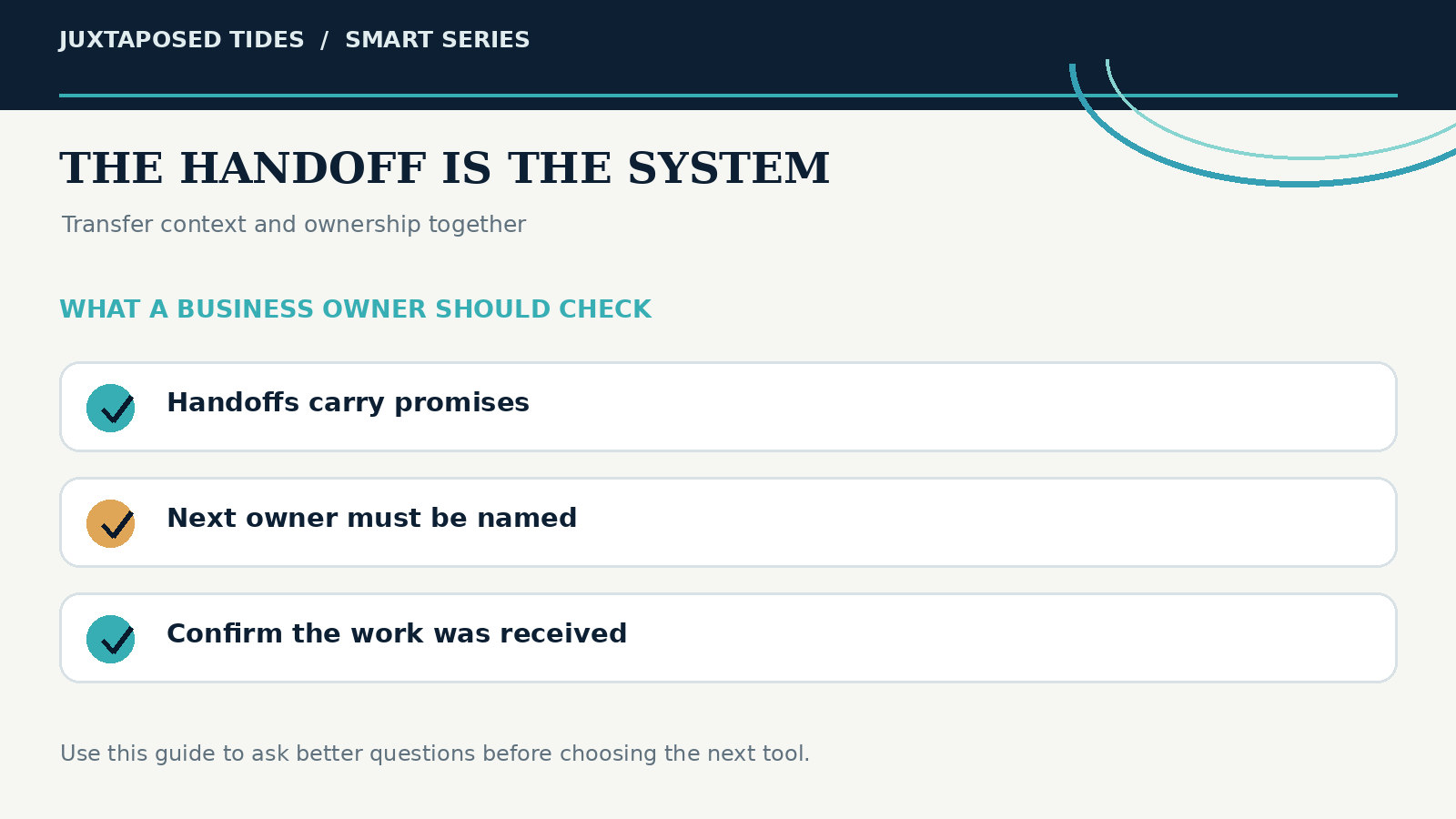
The control should match the consequence. The Handoff Readiness Check Before transferring work, ask: Is the prior stage actually complete? Is the record identifiable? Is the current condition clear? Are customer expectations documented? Are promises visible? Are exceptions approved? Are open questions assigned? Are required documents present? Is the receiving owner named? Is the due time clear? Is the source of truth identified?
Can the receiver act without contacting the customer for information already supplied? Can the receiver reject an incomplete handoff? Will the sender remain responsible until acceptance? Is the customer told what happens next? If the answer to several questions is no, changing the status to “handed off” does not improve reality. Closed-Loop Handoffs A strong handoff is closed-loop. 1. PREPARE The sender assembles the required context and evidence.
2. TRANSMIT The handoff enters the agreed channel or system. 3. ACKNOWLEDGE The receiver confirms receipt. 4. VALIDATE The receiver checks completeness and authority. 5. ACCEPT Ownership formally moves. 6. ACT The receiver begins the next required step. 7. CONFIRM The system records that the transition succeeded. If validation fails, ownership should not disappear into the gap. The process must define whether the sender retains responsibility, the receiver owns correction, or a separate exception owner intervenes.
“Not my department” is not a recovery path. Automation and Handoffs Automation can strengthen handoffs by: Creating the next record Copying approved context Assigning the receiver Starting timers Checking required fields Preventing transitions when information is missing Alerting on unaccepted work Notifying the customer Creating audit evidence Escalating overdue acceptance Automation can also make handoffs worse.
It may create a record without the relevant history. It may mark the sender’s task complete before the receiver accepts. It may route based on stale information. It may generate duplicate projects. It may send a customer message before a human approves an exception. It may move work so quickly that nobody notices the context was wrong. Automating a status change does not automate understanding. The business rule must define what the transition means.
The Human Handoff Conversation Some handoffs deserve a conversation. Complex projects High-risk customers Sensitive cases Major exceptions Large accounts Escalated support issues Situations involving significant emotional context A structured conversation may cover: What matters most What has been promised What is unusual What could go wrong What the receiver should watch What the customer expects next Which decisions remain open
Who owns immediate communication The conversation should supplement the shared record, not replace it. If the only complete context exists in a meeting nobody recorded, the system still depends on memory. Measuring Handoff Health Useful handoff metrics include: Time from sender completion to receiver acceptance Percentage accepted within standard Incomplete-handoff rate Rejection or correction rate Customer information repeated after transition
Promises discovered late Tasks reopened because prior-stage work was incomplete Time lost waiting for context Unowned work between stages Customer complaints linked to transitions Duplicate records created during transfer Exceptions without approval evidence Do not measure handoffs merely to create a leaderboard of blame. Measure them to identify where the system routinely asks people to compensate. The Internal Service Standard
Every team provides a service to the next team. Sales serves onboarding by transferring accurate commitments. Onboarding serves delivery by validating readiness. Delivery serves support by documenting the implementation. Support serves operations by surfacing recurring failures. Finance serves customer-facing teams by making account status understandable. Leadership serves everyone by defining rules and approving exceptions.
An internal service standard should state: What the next team may expect What information will be provided How quickly In what form What completeness means How exceptions are handled What the receiving team owes in return Internal clarity improves external experience. The customer should not feel the organizational chart every time their work crosses a boundary. The Smart Handoff Standard A handoff is healthy when:
The trigger is clear. The sender and receiver are named. The minimum complete context is defined. Promises and exceptions are visible. Sources of truth are known. Timing expectations exist. Receipt and acceptance are different events. The receiver may identify incomplete work. Ownership does not disappear during correction. The customer understands what happens next. Evidence proves the transfer. Failures become visible and escalate.
The business learns from recurring breakdowns. The Final Reality The handoff is not administrative detail surrounding the real work. The handoff is the mechanism that allows the real work to remain coherent as it moves. A company can have excellent marketers, excellent salespeople, excellent technicians, excellent support representatives, and excellent accountants—and still deliver a poor experience because excellence repeatedly falls into the gaps between them.
The salesperson did their job. The automation ran. The record was created. The email was sent. The project manager was notified. The customer still had to explain everything again. Individual completion is not system success. A handoff is successful only when the next person receives the information, authority, timing, and responsibility required to continue the work—not merely when the first person sends something.
The customer is not purchasing a series of departmental accomplishments. The customer is purchasing one outcome from one business. Design the transitions accordingly. UP NEXT — PART FOUR Automation Does Not Fix Chaos: It Repeats the Existing Process Faster, More Consistently, and at Greater Scale Part Four examines what must be true before a workflow is automated, which decisions should remain human, how to design exception and recovery paths, and why automation applied too early turns confusion into scheduled confusion.
Further Reading and Original Research
These independent resources are provided so you can explore the evidence and check important recommendations for yourself.
Continue With Juxtaposed Tides


Comments