

AI Agents for Small Business: Useful Work, Real Limits, Better Decisions


JUXTAPOSED TIDES SMART SERIES
An AI agent is software that can work through multiple steps toward a goal, sometimes using other apps. A chatbot usually answers what you type; an agent may also look something up, draft a reply, update a record, or request to use a tool. That freedom is useful only when the task, data, and permissions are understood.
The New Software Question Is Not “Can AI Do This?”
In 2026, almost every business software category is adding an agent, copilot, assistant, autonomous workflow, or “digital employee.” The language is changing faster than most owners can evaluate it. A chatbot answers questions. An assistant drafts material. An automation moves information when a rule fires. An AI agent can be given a goal, choose among available tools, perform multiple steps, observe the result, and decide what to do next.
That additional freedom is what makes agents valuable—and what makes careless adoption dangerous. A small business does not become smarter because a model can click buttons, send messages, update records, or trigger payments. It becomes smarter when the agent is placed inside a clearly designed workflow with controlled permissions, reliable data, measurable outcomes, and a named human owner.
An AI agent is not an employee, a strategy, or an operating system. It is a decision-making software layer acting inside the system you give it.
This distinction matters. The same agent that saves hours in one business can create confusion, privacy exposure, bad customer experiences, or financial loss in another. Juxtaposed Tides makes the same point in Why AI Cannot Build Your Dream Site: powerful generation does not remove the need for informed ownership and validation.
What an AI Agent Actually Does
A practical business agent usually combines five elements: a model that interprets language and reasons through a task; instructions that define its role; business data that provides context; tools or integrations that allow it to act; and controls that limit what it may do. A sixth element—evaluation—is what tells you whether it is helping.
For example, a lead-response agent might read a form submission, classify the request, check service-area rules, look for an existing CRM record, draft a response, create a follow-up task, and route unusual cases to a person. That is more than a single automation because the agent interprets context and may choose different paths. It is less than a trustworthy employee because it does not understand your business, customer, legal duties, or reputation the way a responsible human owner must.
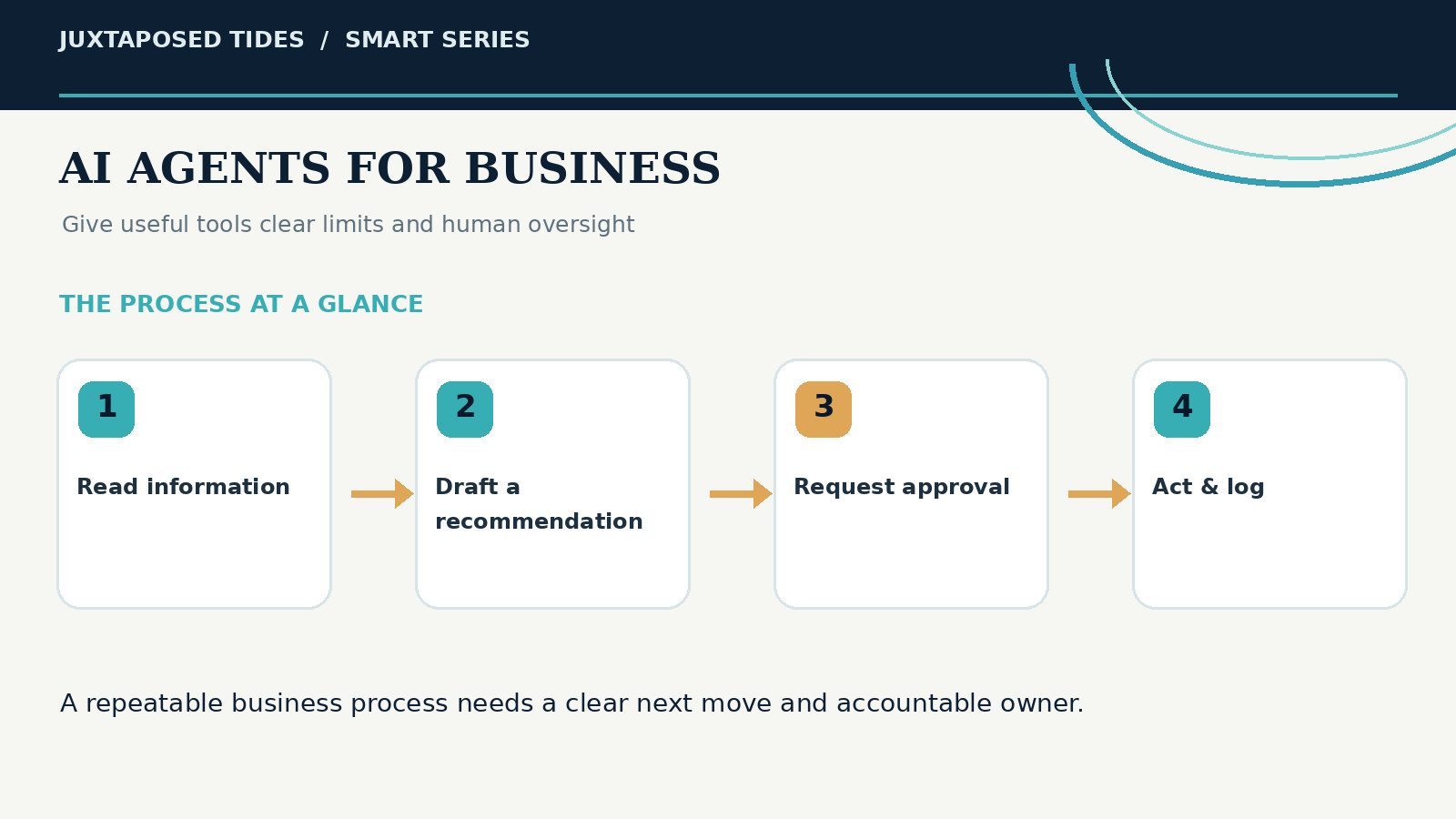
A visual guide to the key stages and responsibilities discussed in this article.
Primary sources such as Anthropic: Building Effective Agents, OpenAI Agents Guide, and Microsoft Copilot Studio Documentation describe agents in different technical ecosystems, but the business principle is consistent: the agent needs a goal, tools, context, and boundaries.
High-Value Uses for a Small Business
The best first uses are usually repetitive, high-volume, easy to review, and reversible. The agent should reduce clerical friction without receiving irreversible authority. Lead triage: categorize inquiries, identify missing information, and assign the correct next step. Inbox and ticket routing: summarize requests, detect urgency, suggest replies, and send edge cases to a person. Knowledge retrieval: answer internal questions from approved policies, product information, and process documentation.
Meeting and project administration: capture decisions, create tasks, identify owners, and flag overdue dependencies. Content operations: repurpose approved source material, draft variants, prepare briefs, and maintain content inventories. Customer preparation: assemble onboarding packets, appointment instructions, order summaries, or renewal information. Data hygiene: detect duplicate records, inconsistent fields, missing values, and likely classification errors for review.
These are useful because the agent operates within a narrow lane. It supports the work without becoming the final authority on money, law, safety, employment, customer promises, or sensitive data.
What an AI Agent Should Not Control Alone
A small business should be extremely cautious about giving an agent unilateral power over high-impact decisions. That includes hiring or firing, credit or eligibility, refunds above a defined threshold, contract commitments, legal advice, medical or safety guidance, deletion of business records, payroll changes, banking actions, security configuration, or public crisis communication.
The risk is not only “hallucination.” Agents can misunderstand incomplete context, follow malicious instructions hidden in data, use the wrong customer record, call the wrong tool, repeat an action, expose private information, or optimize the metric they were given while damaging the outcome you actually care about. The OWASP Top 10 for Large Language Model Applications is a useful starting point for understanding prompt injection, sensitive-information disclosure, excessive agency, insecure output handling, and other common risks.
The Five-Lane Permission Model
Before deploying an agent, classify each action into one of five lanes: Read: the agent may retrieve approved information but cannot change it. Recommend: the agent may propose a classification, response, or next step for human approval. Draft: the agent may prepare content or records but cannot publish, send, or finalize them. Act with limits: the agent may complete low-risk actions inside clear thresholds, with logging and reversal.
Prohibited: the agent may not access or perform the action under any circumstances. This model turns a vague “AI policy” into operating architecture. It also gives vendors and developers something testable. The question becomes not whether the agent is smart, but whether its permissions match the consequences of being wrong.
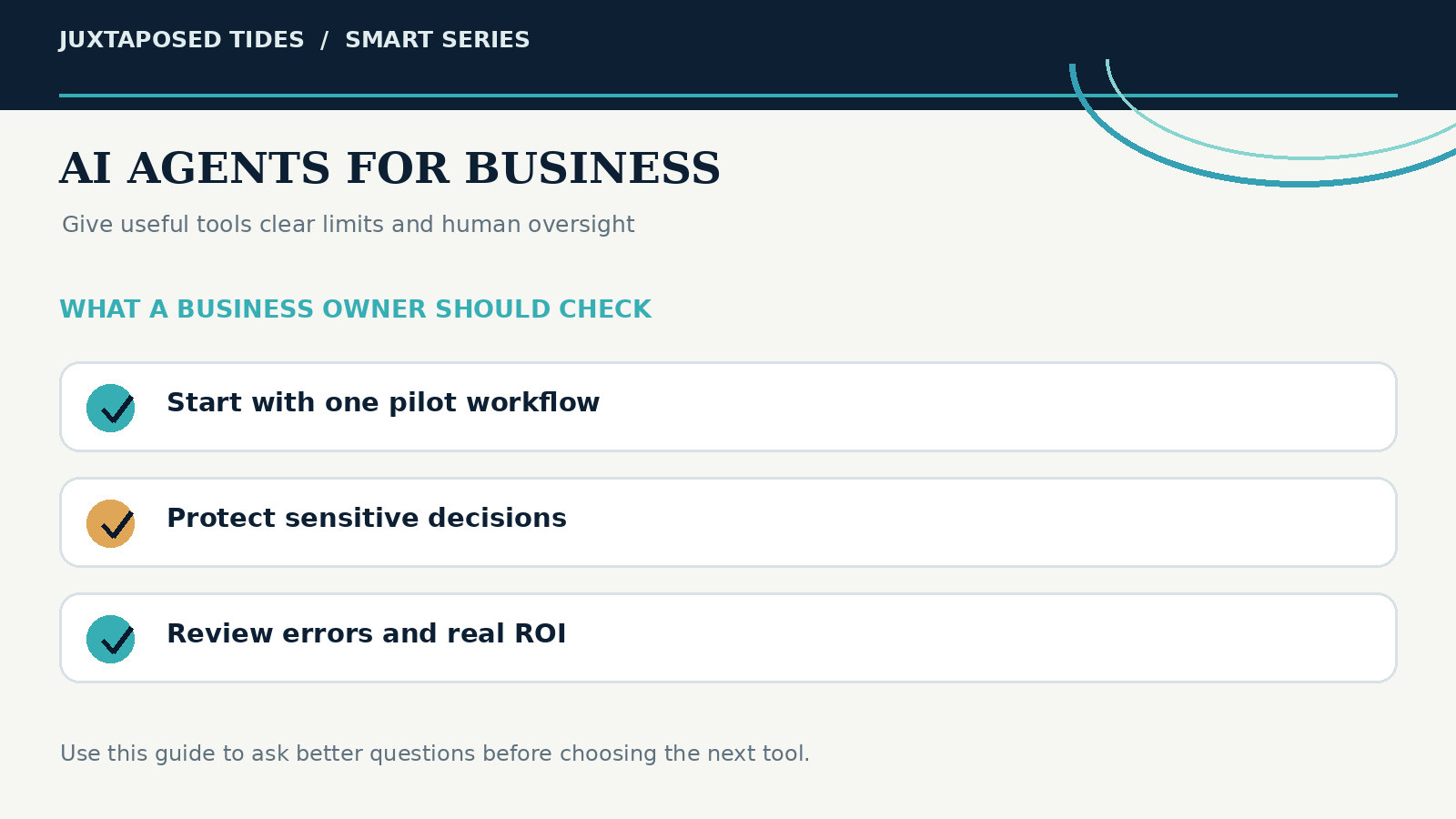
A practical review of the decisions and safeguards that make this process dependable.
The Readiness Test Before You Buy
Your business is not ready for an agent simply because you are busy. It is ready when the workflow has a clear trigger, known inputs, defined outputs, an owner, approved source information, exception rules, and a measurable success condition. If the process changes every time or lives only in one person’s head, the agent will automate ambiguity.
Read From Tabs to Traction: Building a Simple Business OS on Wix before connecting an agent to a scattered operation. An agent needs a business operating path. It should not become the path.
A Better First Pilot
Choose one narrow workflow that happens often, costs real time, and can be reviewed quickly. Run the agent in recommendation mode first. Compare its output to the human baseline. Track accuracy, completion time, escalation rate, customer impact, and correction time. Only then consider allowing limited actions.
The smartest small-business AI strategy is not maximum autonomy. It is earned autonomy. Every new permission should be granted because evidence shows the agent performs reliably inside that specific boundary.
The JT Smart Series Position
AI agents will become a normal layer in business software, but normal does not mean harmless or automatically useful. The winner will not be the business with the most agents. It will be the business that knows what each agent is responsible for, what data it may use, what actions it may take, when a human must intervene, and how value is measured.
Start with JT Smart Series, map the workflow, and make the agent prove that it deserves a place in the system.
Further Reading and Original Research
These independent resources are provided so you can explore the evidence and check important recommendations for yourself.
Continue With Juxtaposed Tides


Comments