

Small Business Tech Stack: Build for Your Business Model, Not the Hype


JUXTAPOSED TIDES SMART SERIES
Your tech stack is simply the group of digital tools your business uses together: perhaps a website, email service, calendar, customer list, payment processor, and accounting program. The best stack is not the one with the most apps. It is the one you can understand, afford, secure, and maintain.
The Wrong Question Is “What Tools Do Successful Businesses Use?”
New founders are surrounded by software lists. One creator says every startup needs Notion, Slack, Stripe, HubSpot, Zapier, Shopify, Airtable, QuickBooks, and five artificial intelligence subscriptions before the logo is finished. Another founder swears that one all-in-one platform replaced everything. A third says the only “serious” path is custom software.
The problem is not that these people are always wrong. The problem is that their answers were built around their customer journey, operating model, team, risk level, technical capacity, and revenue engine. Your business may share almost none of those conditions.
A residential cleaning company, a subscription education business, a mobile food operation, a consulting firm, a regional manufacturer, and a two-sided marketplace may all need a digital presence. They do not need the same small business tech stack. Copying the tool list without copying the underlying business model is how startups pay for impressive software that never becomes a useful system.
The core rule: Your tech stack should follow the work. The work should not be distorted to justify the tech stack.
What a Small Business Tech Stack Actually Is
A tech stack is not a pile of subscriptions. It is the connected set of platforms, tools, rules, data flows, permissions, and responsibilities that allow the business to operate digitally. It includes the visible customer-facing layer—such as your website, store, booking system, or app—and the less visible operational layer behind it.
At minimum, most digitally enabled startups must make decisions across six areas: discovery, conversion, customer management, delivery, money, and measurement. Some businesses can handle those areas inside one managed platform. Others need several specialized systems connected carefully. A smaller number genuinely need a custom platform because their competitive advantage depends on workflows that standard products cannot support.
The United States Small Business Administration recommends starting with market research and competitive analysis to understand demand, market size, customer characteristics, and competitive advantage. That same research should shape your technology choices. Review the SBA’s guidance here: Market Research and Competitive Analysis.
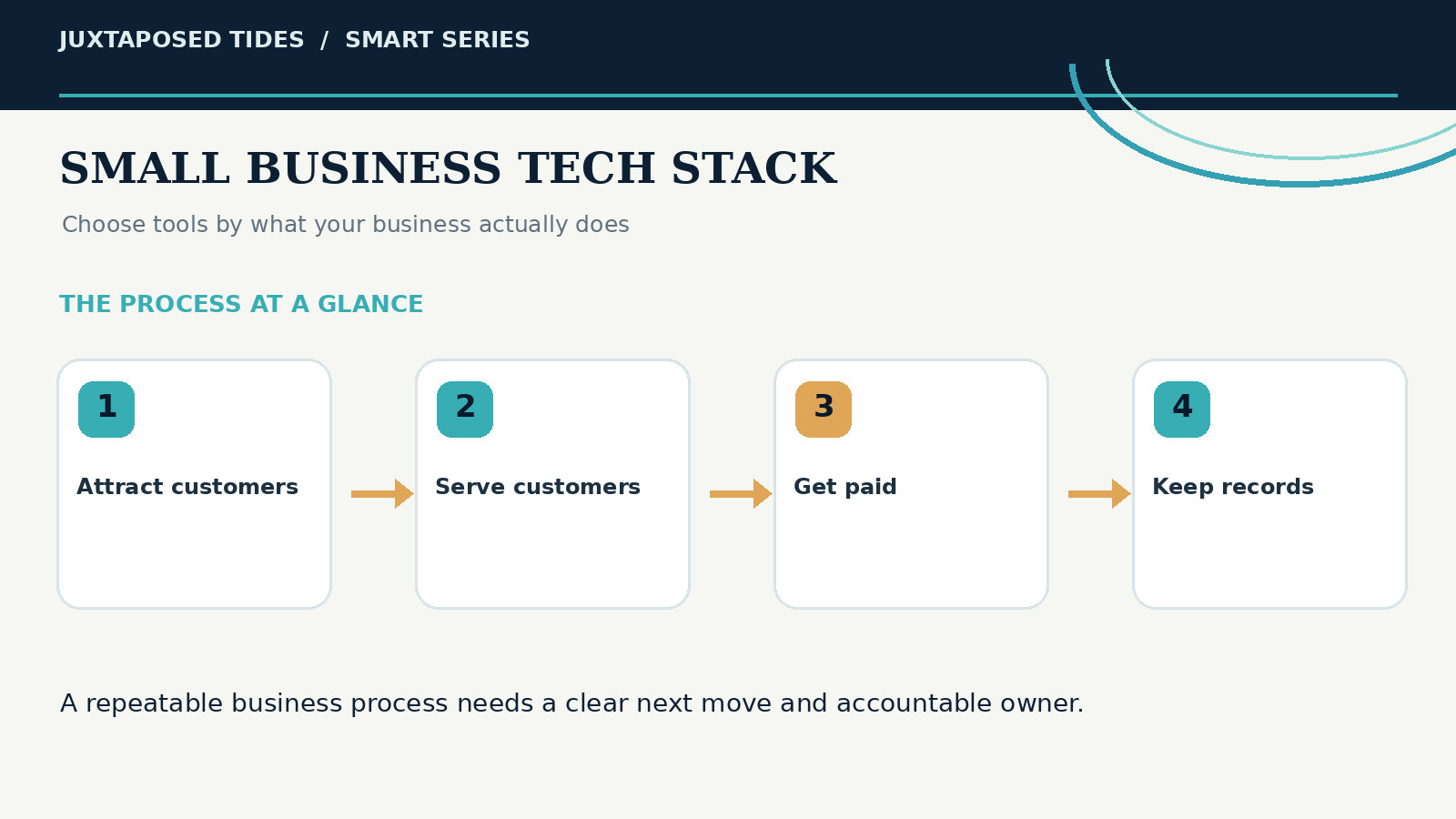
A visual guide to the key stages and responsibilities discussed in this article.
Start With the Business Model, Not the Software Category
Before comparing platforms, write down how value moves through the business. Who is the customer? What causes that customer to act? What do they buy? How do they pay? What must happen after payment? What information must move from one person or system to another? What does a successful outcome look like?
For a local service company, the essential flow may be: local discovery, quote request, qualification, scheduling, reminder, service delivery, payment, review request, and repeat booking. For a business-to-business consultancy, the flow may be: educational content, lead capture, discovery call, proposal, contract, deposit, project delivery, reporting, renewal, and referral. For an online retailer, the system must also account for product data, inventory, tax, fraud, shipping, returns, and support.
Those flows tell you what the stack must do. They also expose what it does not need to do yet.
The Seven Questions Every Tool Must Answer
Every proposed platform should survive seven questions before it enters the stack. What business problem does it solve? “Everyone uses it” is not a business problem. Who owns it? Someone must be responsible for configuration, upkeep, permissions, and results. What data enters it? Define customer, financial, operational, and content data clearly. What data leaves it? A useful tool must hand information to the next step without manual retyping whenever practical.
What happens when it fails? Identify workarounds, backups, and service dependencies. How do you leave? Know whether you can export contacts, orders, content, files, and history in usable formats. What must be true before it creates value? Some tools require clean data, disciplined staff behavior, or a stable process before they help. This is why a cheap subscription can become expensive and an expensive platform can become economical. Price matters, but fit, ownership, integration, and operational burden determine the real cost.
Build a Minimum Viable Stack, Not a Minimum-Cost Stack
A minimum viable stack is the simplest system that can deliver the customer promise reliably, protect essential information, and produce enough data to improve. It is not necessarily the least expensive set of tools available. A free plan that forces duplicate entry, breaks the handoff, hides important data, or cannot support the transaction is not lean. It is deferred cost.
For many startups, a strong first stack may include a managed website platform, domain and business email, forms or booking, a basic CRM, payments or invoicing, accounting, file storage, analytics, and a password manager. The exact products matter less than whether the pieces form one understandable operating path.
Juxtaposed Tides explains this principle throughout the JT Smart Series and the Build Smart Series overview: the goal is not to collect templates or chase trends. The goal is to make choices that fit your capacity, budget, and desired future.
Do Not Confuse Optionality With Flexibility
Founders often choose a platform because it can theoretically do almost anything. That sounds flexible. In practice, unlimited possibility can create unlimited configuration, maintenance, plugin dependence, and decision fatigue. Real flexibility means the system can support the changes your business is reasonably likely to make without requiring constant expert intervention.
A platform that gives you fewer choices but handles hosting, security updates, forms, payments, CRM, and automations in one controlled environment may be more flexible for a small team than an open system that can do everything but requires separate specialists to keep it healthy. For another business—with a development team and unusual requirements—the open or custom path may be exactly right.
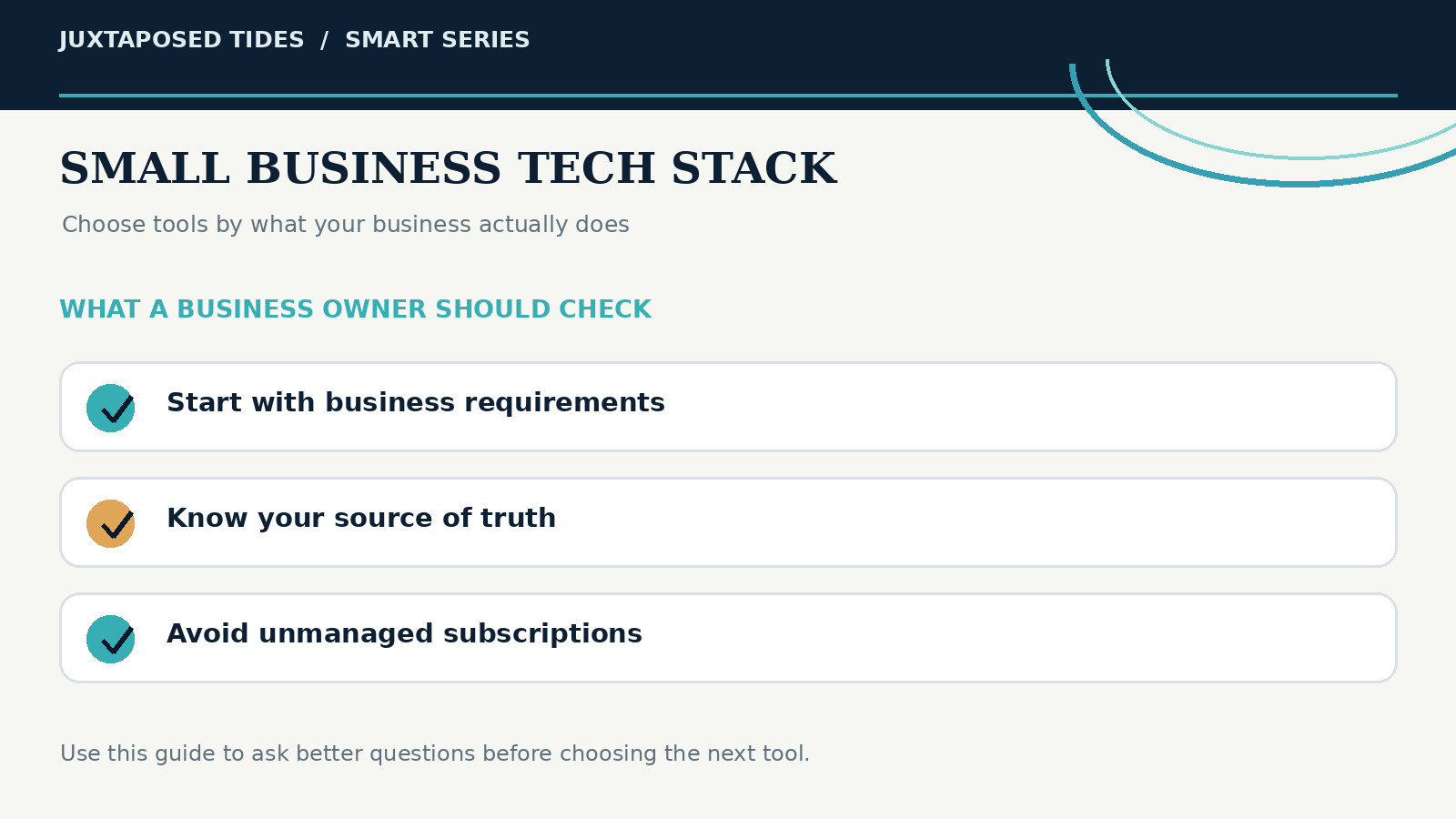
A practical review of the decisions and safeguards that make this process dependable.
There is no universal winner. There is only a responsible fit decision.
Security Belongs in the First Draft
Security is part of the stack architecture, not a feature to add after customers arrive. At minimum, use multifactor authentication, unique passwords stored in a password manager, role-based access, reliable backups, software updates, secure payment providers, and a clear process for removing access when a contractor or employee leaves.
CISA provides small-business cybersecurity resources covering phishing, passwords, multifactor authentication, updates, logging, backups, and encryption: CISA Small and Medium-Sized Business Resources. The FTC also maintains practical small-business cybersecurity guidance: Cybersecurity for Small Business.
The best startup stack is not the one with the most integrations. It is the one you can understand, secure, maintain, and improve.
The Startup Stack Scorecard
Before approving a tool, score it from one to five on: Business-model fit Customer-experience fit Ease of ownership Integration quality Data portability Security and permissions Current cost and likely growth cost Implementation effort Vendor reliability Ability to support the next realistic stage A platform that wins on features but loses on ownership, security, and implementation is not the best choice. It is a future bottleneck with good marketing.
Build the System Your Business Can Actually Run
A new business does not need to look technologically impressive. It needs to work. The website must send the right people toward the right action. The CRM must show who owns the next step. The payment system must be dependable. The delivery tools must reduce confusion. The analytics must answer real questions. The owner must know how the system is supposed to behave.
Before buying another tool, read Stop Making Panic Decisions: Strategically Choose Your Next Digital Platform. Then document your own business model, customer path, workflow, data, risk, and ownership needs. The businesses that build well from the beginning are not the ones that predict every future feature. They are the ones that establish a clear architecture, make deliberate trade-offs, and refuse to confuse someone else’s success path with their own.
Further Reading and Original Research
These independent resources are provided so you can explore the evidence and check important recommendations for yourself.
Continue With Juxtaposed Tides


Comments