
The Myth of the "AI Button": The Fatal Gaps Between Commercial Promise and Commercial Reality in 2026

An Exhaustive Case Study in Why AI is a Tool, Not a Tradesman
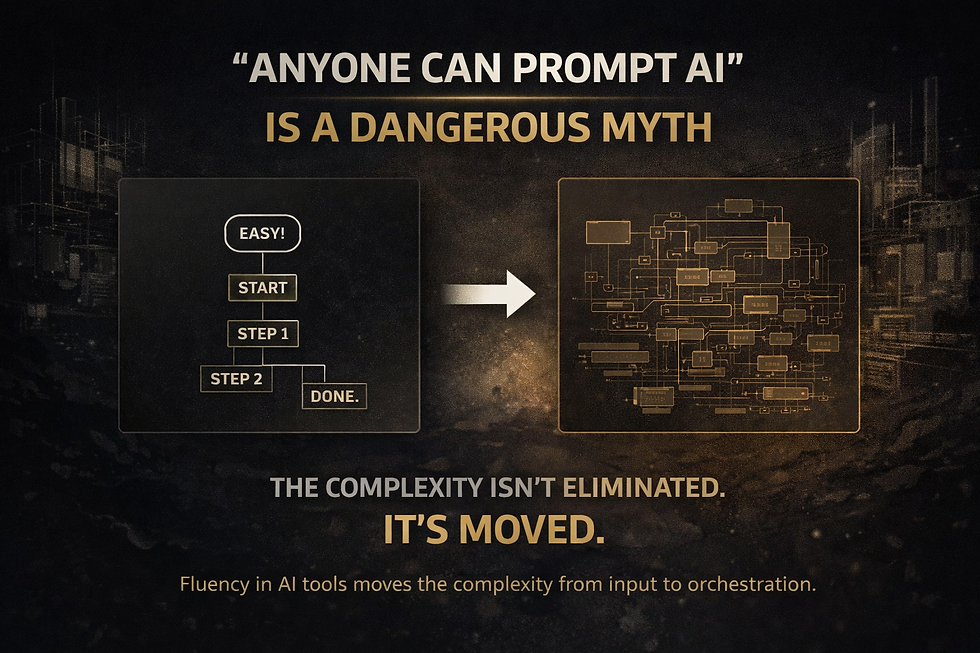
Let's be absolutely clear from the outset: This is not a dismissal of AI. That would be as foolish as dismissing electricity because you can't drink it. The modern AI revolution—

particularly in the realms of large language models (LLMs), code generation, and design automation—represents the most significant acceleration of creative and technical possibility since the advent of the internet itself. At Juxtaposed Tides, we use these tools daily. They are our co-pilots, our brainstorming partners, our tireless junior developers who never sleep.
The dangerous myth isn't that AI exists and does things. It's the fantasy being sold in slick, 30-60-second commercials: that you, the great business visionary, can simply "talk to an AI" and receive, as if from a digital vending machine, a complete, operational, robust, secure, scalable, and effective business platform.
This fantasy collapses the moment you move from the idea of to the act of building. It mistakes the generation of artifacts for the orchestration of a system.
Let us dissect this with surgical precision, using a real-world artifact: the file structure of a current, in-development project. This isn't hypothetical. This is the living, breathing, complex organism we are constructing. No, not with with drag and drop features (except it is a brief moment of relief when we can...thanks to the likes of Wix and Elementor ((for wordpress)), etc.), this is built with an altogether different beast. It a tech stack as follows:
Frontend
React 18 - UI library
Tailwind CSS - Styling
Shadcn UI - Component library
Leaflet - Interactive maps
Recharts - Analytics charts
React Router - Navigation
Axios - API calls
React Helmet Async - SEO management
Backend
FastAPI - Python web framework
MongoDB - Database (via Motor async driver)
Pydantic - Data validation
bcrypt - Password hashing
Third-Party Services
Stripe - Payment processing
Cloudinary - Image storage & moderation
Resend - Transactional emails
Google OAuth - Social authentication
Google Analytics 4 - Visitor tracking
Microsoft Clarity - Heatmaps & session recordings
Think of like this: take a motorcycle technician, for instance. A real one, not one of those 'shade-tree surgeon mechanics', but a motorcycle tech.
Following is what their client sees:


But here is what they (the tech, of course) had to look at to get it there, even something simple as a repair, (not to mention building one from scratch, which may even include digging the iron ore from the dirt, literal ground zero, aka how a business website is built when from scratch: from the very mines of your precious-metal-like mind....once again, I'll digress):

And that is just the index...

It is so funny, especially to motorcycle techs, that all the person getting their machine back wants is that "idea of", not concerned with how the tech got there, those six stripped bolts due to lack of proper maintenance, all the way to that axle that hadn't seen grease since '92... They just want:
[enter motorcycle, clean and finished, ready to roll)...
But for the motorcycle technician, it is all about that path that it takes to get from nothing to the final "idea of"...
It is the same for us (web/tech developers)...
So, you, the business owner decided you want to sell your mailable bouquets on your (future, not yet built = "idea of", this is a business, have you LLC'd or S Corp'd? How about opened a professional business bank account, oh, even that part gets deeper and deeper...but just hold on) really cool and operational website. You know you need at least 5 pages, just to show home, who you are, products, more info, plus SEO so you are actually found by your desired clientele (yeah, not just anyone)... And that is just a little layout thinking, it goes way deeper.

But, lets say you actually fall in the quicksand, alone, and somehow do get yourself back near the edge without sinking into the abyssal despair: now, you want to accept payments, with all your different price points across your products, and you want the perfect and SAFE and secure checkout process for your clients. Time to set up something "so simple and basic" as Stripe payments. BUT... .that kind of looks like follows...oh, and good luck with that learning curved...:
So, if you have done this anything like a professional developer will, you will be looking at a spagetthi-mess-to-the-untrained-eye of folders and files with a COMPLETE LANGUAGE OF ITS OWN... Oh, that's right, not just one, but so many... just for development alone, JavaScript, HTML5, Python, etc. but also each of the other numerous software and API you will need to run the whole thing (Stripe, MongoDB, Google AUTH ((that's how you have your clients sign in securely, boy, that'd be nice, huh?)), Cloudinary, etc. These all have their own respective languages inside each technology...

If you don't know how to talk to AI or better yet sweet talk to AI, you don't stand a chance as far as "money savings" are concerned. Please, we beg that you try it, implore the ole "ai can build it for me" concept. By the end of it, you will be neckdeep, begging for a shotgun or the help of a friendly, and hopefully sympathetic, developer who has been in the quicksand, and knows what a human hand reaching out to help can really mean. Whether you use the shotgun to absolutely obliterate your computer, OR now have a professional untangle your mess, you can bet either route will be expensive...
Go back to the motorcycle technician metaphor: if you decide, "well, I do have a wild hair up my ass... I think I'll install that and do all the wiring myself. Manual...haha I'm a man, don't need a stinking manual...". Next thing you know, that mess of sphagetti under your $13,000 machine is causing nothing to work. And you better believe when you get to your favorite tech's shop, you are getting charged double for the trouble (should've brought it here first is an age-old adage, especially if you don't have the patience of a person still using a 2005 Celeron laptop and a desire to conquer more learning curves than honors Calculus...)...
PART I: THE REALITY OF A BUSINESS PLATFORM – IT'S NOT A WEBSITE, IT'S AN ECOSYSTEM
Look at the file tree you've provided. Don't just scan it. Read it. Absorb what each directory and file represents:
text
backend/
├── auth_middleware.py       # Who are you, and what can you do?
├── payment_routes.py        # How does money move securely?
├── email_automation.py      # How does the system communicate?
├── google_sheets_sync.py    # How does it talk to your existing data?
├── background_scheduler.py  # What happens when no one is looking?
├── data_importer.py         # How do we get 5,000 Walmart locations into a usable format?
├── content_moderation.py    # How do we keep the community safe?
└── ...and 40+ more.
Each of these files isn't a "page." It's an organ. It's a subsystem with responsibilities, failure modes, and intricate connections to every other organ. The email_automation.py file doesn't just "send emails." It:
Checks the user's subscription status (talks to stripe_subscription_service.py).
Pulls personalized content based on their activity (talks to the database via models.py).
Handles failures gracefully (if Mailgun is down, it queues and retries).
Logs everything for analytics and debugging (feeds analytics_sheets.py).
This is the "behind the scenes" that the AI commercial does not, and cannot, show you.
Why? Because showing geocoding.py and explaining its need to handle API rate limits, cache results, and fail gracefully without crashing the user's trip planner isn't sexy. It's the plumbing. And a business drowns when its plumbing fails.
PART II: THE COSTS OF THE AI-ONLY PATH – A TRIAD OF TRAGEDIES
The promise is: "AI will save you money on developers!" Let's audit the true costs, which are always paid, whether in currency, time, or risk.
Cost 1: The Fluency Tax
The fundamental lie is that "anyone can prompt." This is like saying "anyone can perform surgery" because they can describe where it hurts. Let's define fluency levels:
Tourist Prompting: "Build me a website for finding cool places."
AI Output: A generic landing page with a title, a stock photo, and a non-functional "Explore" button. It is a digital mirage.
Business-Verse Prompting: "Create a React component for a map dashboard that uses Leaflet, integrates with a REST API endpoint at /api/user/trips, displays geojson data, and has a filterable sidebar powered by Zustand for state management."
Prerequisite Knowledge Required: React, component architecture, Leaflet API, RESTful API patterns, GeoJSON data structures, Zustand state management. You must already be a mid-level frontend developer to write this prompt.
Systems-Verse Prompting (The Impossible Ask): "Create a secure, scalable backend with OAuth2 authentication, a scheduled job that syncs user-generated content to a Google Sheet every 4 hours with deduplication logic, a Stripe subscription webhook handler that updates user roles and triggers a welcome email sequence via SendGrid, and ensure all database queries are sanitized against SQL injection."
This prompt is impossible. The AI cannot hold this level of systemic complexity in a single context window. It would generate a broken, insecure skeleton. To even attempt this, you must decompose it into 50 discrete, expertly crafted prompts. You must be a senior full-stack architect and DevOps engineer to guide the AI through this process.
The Fluency Tax states: The value you extract from an AI is directly proportional to the expertise you bring to it. The less you know about the actual craft (software architecture, security, databases, APIs, not to mention at minimum business basics, otherwise, how do you plan to "build that great business"...), the more expensive and time-consuming the AI path becomes, as you must first acquire that expertise through trial and often catastrophic error.
Cost 2: The Integration & Glue Work Abyss
An AI can generate a beautiful Login.jsx component. It can even generate a decent auth_routes.py stub.
But can it:
Ensure the JWT token from the backend is stored securely in the frontend, not in localStorage?
Configure the admin_middleware.py to correctly validate that token's role claims on every admin request?
Write the email_service.py to send a password reset link that integrates with the frontend's /auth/reset-password route?
Set up the background_scheduler.py to purge expired tokens from the database nightly?
This is glue work. It is the meticulous, unglamorous wiring that connects individually generated components into a coherent, secure whole. AI is catastrophically bad at this because it works in isolated, prompt-sized contexts. It has no memory of the system it's building. The human developer's primary role in the AI-augmented process is not writing code, but being the system's persistent memory and architect, directing traffic, spotting gaps, and applying the glue. This is the highest-order cognitive work, and it cannot be automated.
Cost 3: The Accountability Vacuum & Technical Debt Tsunami
When your AI-assembled "platform" breaks at 2 AM because the geocoding.py module you prompted for didn't handle a null response from the Google API, who fixes it?
You are now on call. You must diagnose an error in a codebase you didn't truly build and don't deeply understand.
Your fix is another prompt: "My geocoding function broke with error 'TypeError: Cannot read properties of null.' Fix it." The AI gives you a new function. Does it break the data_importer.py that depends on its old output format? You don't know. You've just taken on unintended technical debt.
This debt compounds with every "fix." The system becomes a fragile Jenga tower of AI-generated snippets, held together by hope and duct-tape prompts. The cost to eventually rebuild it correctly will dwarf the original investment in professional development.
PART III: THE JUXTAPOSED TIDES MODEL – AI AS POWER-TOOL, HUMAN AS MASTER CRAFTSMAN
This is our actual workflow. It is the synthesis, not the replacement, of intelligence:
Human-Directed Strategy & Architecture: We meet with you. We learn about your business, your users, your regulatory constraints (GDPR, HIPAA, payment card industry standards). We whiteboard the system. We define the entities (User, Trip, Store, BlogPost), their relationships, and the critical flows. This is 100% human. No AI can do this discovery.
AI-Augmented Execution:
Scenario: We need to build the email_sequences.py module for a post-trip follow-up sequence.
Human Action: I write the prompt: "Generate a Python class PostTripSequence that integrates with the existing EmailService class (has method send_templated_email(user_id, template_name, context)). The sequence should: 1. Send a 'Thanks for logging your trip!' email 1 hour after trip creation. 2. Send a 'Rate your experience' email 3 days later. 3. Send a 'You've earned a badge!' email if the trip was marked as verified. Use a background task queue model."
AI Action: Generates 80% of the boilerplate, correctly structured.
Human Action: I review the code. I see it used a generic queue. I modify it to use our project's specific Celery setup. I add error handling for the case where a user deletes their account between emails. I write the integration test. I apply the judgment, context, and systems thinking.
Human-Owned Systems Integration & Quality Assurance: We are the conductors. We ensure the google_sheets_sync.py (perhaps AI-drafted) talks correctly to the gamification.py module. We write the tests/ that prove the whole system works under load. We configure the deployment pipeline and monitor performance. We own the accountability.
The File Tree You See Is the Artifact of This Process. Every file in backend/ and src/ is the result of a deliberate, human-led decision about the system's needs, iteratively built with powerful tools.
CONCLUSION: BUYING THE REALITY, NOT THE COMMERCIAL
The commercial sells you a fantasy: "You, the idea person, plus AI, can bypass the expensive, complicated builders."The reality we offer is the adult truth: "You, the business owner, plus us, the expert builders armed with AI power-tools, can build a competitive, resilient, and valuable asset faster and more robustly than ever before in history."

The question is not "Can AI build my website?
"The answer to that is a trivial, "Yes, a very bad one."
The real question is: "Do I want to spend the next 6 months becoming an unpaid, frustrated, and novice systems architect, debugger, and helpdesk technician, ultimately holding a fragile prototype?"
Or, do I want to partner with a team that has already paid that fluency tax, that owns the glue-work and accountability, and that uses the very best tools—both silicon and carbon-based—to build you a real business engine?
The file tree is the evidence. It is the map of a complex territory that AI can only describe in fragments. We are the guides who can navigate it, build upon it, and give you the keys to a fortress—not just a sketch of a door.
The future belongs not to those who replace humans with AI, but to those who empower humans with AI. We are already there. The commercial is just catching up to what we're already building.


Comments