
The Great AI Mirage: Why “AI Will Build It” is the Most Expensive Lie in Modern Business

An Exhaustive, Unflinching Examination for the Well-Intentioned but Dangerously Misled

"AI will build this..." "AI will build that..." "No skills needed, just you and your thoughts and AI will pull it out of its...."
So, you’ve seen the ads. The breathless videos. Type a sentence, get a website. “Revolutionary!” “Democratizing!” “The end of developers!” The siren song of the AI website builder is powerful, seductive in its promise of instant, cheap, effortless digital transformation.
And it’s a fantasy. A beautiful, compelling, and catastrophically expensive fantasy.
Let us, with clear eyes and the weary patience of craftsmen watching someone try to build a house with a glitter gun, dissect this illusion. This is not a Luddite’s rant. It is a forensic audit of promise versus reality, of cost versus value, of a tool versus a partner. This is the comprehensive, bone-deep argument for why, when your business’s digital presence and operational backbone are on the line, “AI Can’t Do This.”
PART I: THE SEDUCTION – UNDERSTANDING THE ALLURE
First, we must empathize with the enemy. The appeal is undeniable:
The Illusion of Speed: “Have a website in minutes!” It taps into our deepest impatience.
The Illusion of Simplicity: No talking to pesky humans with questions. Just you and a magic box.
The Illusion of Cost Savings: A monthly fee that seems trivial compared to a developer’s proposal.
The Illusion of Control: The promise that you, the visionary, can directly manifest your idea without translation.
This is the pitch. It’s brilliant marketing. It’s also a profound misunderstanding of what you’re actually buying.
PART II: THE DECONSTRUCTION – THE FIVE CATASTROPHIC GAPS BETWEEN AI AND REALITY
Gap 1: The Chasm Between “Assembly” and “Architecture”
AI builders are phenomenal assemblers of pre-existing parts. Give them a clear, generic goal—“a landing page for a dentist”—and they’ll stitch together a header, a hero image, a services section, and a contact form from their vast library of learned patterns. It will look… fine. Recognizable. A digital clone of ten thousand other dental sites.
What AI cannot do is architect. Architecture asks “why” before “how.” It involves:
Strategic Interrogation: “Is a landing page what you need? Or do you need a patient portal that reduces no-shows by 30% by integrating with your SMS reminder system? Is your goal brand awareness, or is it converting high-value implant consultations?”
Business Logic Engineering: Let’s take our real-world example, AnysizeArt. The core of their business isn’t a “pretty art shop.” It’s a proprietary ordering algorithm. It’s the logic that takes a user’s room dimensions, light conditions, and aesthetic preference, and outputs: “You need 10 X10 of that beautiful image on a tight canvas wrap. We can do the whole process for you!” An AI can make a grid of (semi-real looking) art pictures and even a skeleton/concept of a "good website". But it cannot conceive, design, debug, and implement this complex, interactive decision engine. (Well, let us momentarily digress, because, per say, with the right amount of money (aka thousands), you can get ai to build you something; but credits aren't cheap, and they don't necessarily talk back and answer real questions when the stuff gets DEEP; and trust us, it gets deep...) It doesn’t understand the underlying frame measurement data, the pricing matrix, or the inventory logic. We don’t just build the store; we encode the expertise.
System Design: A business platform is an ecosystem. The website talks to the payment processor (not just Stripe, but splitting payments automatically between the nursery and the logistics partner). It talks to the inventory database (showing “Only 2 left!” and hiding sold-out items). It talks to the email CRM (sending a care reminder 2 weeks post-purchase). AI can insert a “connect to Mailchimp” button. It cannot design the seamless, bidirectional data flows that make a business hum. It builds pages. We build central nervous systems.
Gap 2: The Hall of Mirrors – The Problem of Specificity and the “Almost Right”
AI operates on probability. It generates what is most likely to come next, given its training data.
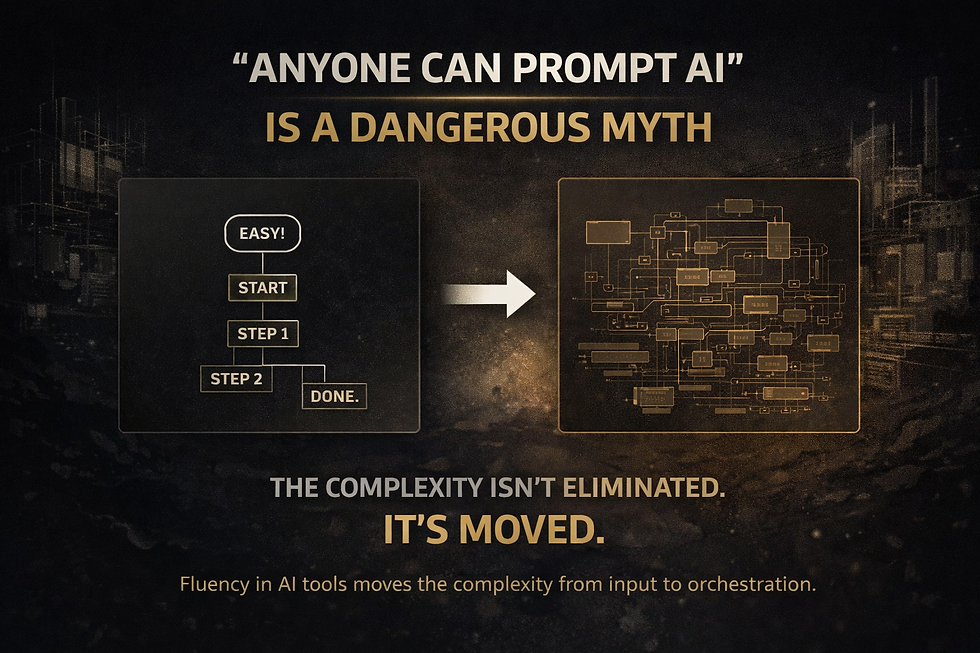
This is fatal for specificity.
The “Generic-to-Specific” Translation Failure: You prompt: “Make a website for my law firm that specializes in maritime intellectual property law for autonomous shipping startups.”
The AI, lacking any real understanding of this preposterously niche field, will generate a generic law firm template. It will have stock photos of gavels, not diagrams of cargo ship sensor arrays. It will have “About Us” text that talks about “dedication and passion,” not about the nuances of applying patent law to machine-learning-based navigational algorithms in international waters.
To fight this, you must become an expert prompt engineer. You’ll spend hours iterating: “No, not that blue. More nautical but not cheesy. The headline should convey expertise in tech and law. The form needs to ask for vessel class and AI system vendor.” You are now painstakingly teaching a machine the basics of your business, one vague correction at a time. This is not saving time. This is the most frustrating form of data entry imaginable.
A professional developer? We become a rapid study. We absorb your niche knowledge through conversation, ask targeted questions, and then apply cross-disciplinary knowledge you don’t have (UX, performance, security) to build the perfect, specific solution. We don’t work from probability; we work from first principles.
The “Almost Right” Bug: AI-generated code is infamous for being “almost right.” It will create a button that looks perfect but has a flawed aria-label for screen readers, breaking accessibility. It will build a responsive layout that works on 9 screen sizes but collapses horribly on the 10th. It will write a function that processes payments but has a subtle race condition that fails 1 in 200 transactions. These bugs aren’t obvious. They’re silent, business-killing failures. Finding and fixing them requires the very expertise the AI promised to render obsolete. You’ve traded a clear development cost for a hidden, pervasive quality debt.
Gap 3: The Phantom of Accountability – Who Owns the Black Box?
When you hire Juxtaposed Tides or any other development studio worth their salt, you hire a single point of accountable human intelligence. If the contact form breaks, you call me. I open the tools, diagnose the problem (a changed API endpoint, a broken validation rule), and fix it. I understand the intent behind the system, not just its output.
With an AI-built site:
The Debugging Nightmare: When something breaks, what is your recourse? You go back to the prompt box. “My form is broken.” The AI, having no memory of your specific build’s structure, generates a new form. Does it match the styling? Does it connect to the same database? Maybe. Probably not. You are now in a perpetual loop of regenerating entire sections, hoping the new version works and doesn’t break three other things. There is no diagnosis, only replacement.
The Update Roulette: The platform the AI builder runs on updates. A core component changes. Your once-working site now has layout issues. You must re-prompt to “fix” it, essentially starting over. Your digital asset is held hostage by the whims of a third-party AI’s training data and model updates.
The Liability Void: If an AI-generated checkout flow has a security flaw that leads to a data breach, who is liable? You. Always you. The AI company’s Terms of Service absolve them of all responsibility. You are left holding the bag, with a system you never understood in the first place. We provide contracts, warranties, and the professional liability that comes with human accountability.
The AI “Cheap” Path:
Direct Credit Costs: To get beyond a generic template, you need premium AI credits/generations. For a full site with custom styling, multiple complex pages, and functionality? $500 - $1,500 in credits.
The Time Sink (The Killer):
Learning the AI Tool: 10-20 hours to move from basic to “competent.”
Prompt Engineering & Iteration: You’re not just describing, you’re fighting vagueness. “Make it pop” vs. “Increase headline font weight to 700 and use a CSS text-shadow of 0px 2px 4px rgba(0,100,0,0.2).” The latter is developer talk. You’ll spend 40-80 hours in this iterative, frustrating loop.
Learning Web Concepts: To prompt effectively, you need to know what’s possible. You’ll find yourself learning about CSS, responsive breakpoints, and API calls anyway. Add 20-40 hours.
Debugging & Fixing: When things are “almost right,” you’ll spend 20+ hours on forums, trying to tweak generated code you don’t understand.
Total Time Investment: 90-160 hours.
The Opportunity Cost: What is your time worth? If you’re a business owner, your hourly rate should be measured in the value you bring to strategy, sales, and operations. Let’s be conservative: $75/hour.
Cost of Your Time: 125 avg hours * $75 = $9,375.
Total AI Project Cost: Credits ($1,000) + Your Time ($9,375) = $10,375.And you have an asset you don’t fully understand, is fragile, and is likely generic.
The Professional Development Path:
Direct Cost: A clear proposal from Juxtaposed Tides for the any given moderate platform: $15,000 - $25,000 (all-in, strategy, design, development, testing, training).
Your Time Investment: 10-20 hours of focused, productive collaboration. You are the domain expert sharing knowledge; we are the translation and execution engine. Your time is spent on high-value strategy, not on learning prompt engineering.
Opportunity Cost: 15 hours * $75 = $1,125.
Total Professional Cost: Project Fee ($20,000 avg) + Your Time ($1,125) = $21,125.
The Reality Check:
The AI path appears to “save” ~$11,000. But this is a phantom saving.
You have paid $10,375 in real cost (your time + credits) for an inferior, risky, unmaintainable asset. You have also lost 125 hours you could have spent acquiring customers or refining your product.
The professional path costs $21,125 for a superior, robust, maintainable, tailored asset and returns 110 hours of your life to focus on your business.
The question is not “Can I get it cheaper with AI?”
The question is: “Do I want to become an unpaid, novice web developer for the next three months, or do I want to partner with experts who will deliver a business tool while I run my business?”
Gap 5: The Competitive Disadvantage – While You’re Prompting, They’re Executing
Your market does not stand still. While you are on your fifty-fifth iteration trying to just get the mobile menu to work, your competitor who hired a professional agency has:
Launched a flawless, fast, converting site.
Integrated their booking system with their CRM.
Set up automated email nurtures that are capturing leads.
Started A/B testing headlines to optimize conversion rates.
Gained 100 new customers from their professional-looking, high-functioning digital presence.
AI gives you a commodity. Professional development creates a competitive advantage. In the time it takes you to learn to use the AI hammer, we’ve already built you a custom-crafted toolkit that puts you ahead of the pack.
PART III: THE PROPER PLACE FOR AI – THE TOOL, NOT THE CRAFTSMAN
This is not an anti-AI polemic. AI is a revolutionary, powerful tool in the hands of a professional. At Juxtaposed Tides, we use AI extensively:
As an Advanced Brainstorming Partner: To generate creative copy variations, suggest UX patterns, or explore visual design directions we would then critically evaluate and adapt.
As a Code Acceleration Tool: To write boilerplate functions, suggest optimizations, or generate documentation. But every line is reviewed, understood, and integrated by a human engineer who owns the final system’s integrity.
As a Research Assistant: To quickly summarize new frameworks or explore integration possibilities.
The key distinction: AI is a layer in our process. It does not replace strategy, architecture, critical thinking, or accountability. It augments expertise; it does not create it.
PART IV: THE IRREFUTABLE ANALOGIES
1. The House Analogy:
You can buy a pre-fabricated shed kit (AI). It arrives with instructions. You and a friend spend every weekend for two months assembling it. It keeps the rain out, mostly. The door sticks. The floor isn’t quite level. You don’t know why.
Or, you can hire an architect and builder (Professional Developer). They listen to your life, design the perfect home for your family’s needs, source quality materials, manage the complex trades (plumbing, electrical), and deliver you the keys to a sound, beautiful, custom home. One is a product. The other is a partnership that yields an asset.
2. The Surgery Analogy:
You could watch a detailed surgical tutorial on YouTube (AI). You could buy some scalpels. You have a problem you’d like fixed.
Or, you could hire a trained surgeon (Professional Developer).Both are “doing surgery.” Only one has a predictable, positive outcome. The other is malpractice. Your business is not a hobby; it deserves the professional.
CONCLUSION: THE UNBREAKABLE VALUE OF HUMAN-CENTERED CREATION
The promise of AI builders is the ultimate reductionist lie: that the immense, multifaceted challenge of translating business vision into functional digital reality can be reduced to a text prompt. It cannot.
What we sell at Juxtaposed Tides is not just a website; is it not just “code.” It is:
Translation: Turning your business passion, idea, or plan into technical specifications that actually execute real time commands and make operating your business easier than ever before.
Strategy: Applying cross-domain knowledge (business, UX, tech) to solve your problems in ways you hadn’t considered.
Architecture: Designing systems that are scalable, secure, and maintainable.
Craftsmanship: Building with attention to detail, performance, and accessibility that machines neglect.
Accountability: Being the human face you can hold responsible for success.
Partnership: Being an extension of your team, invested in your outcomes.
AI can generate a website. It cannot conduct a discovery session. It cannot hear the hesitation in your voice when you describe a problem and ask the clarifying question that unlocks the perfect solution. It cannot make a judgment call between two good options based on a decade of experience. It cannot stand behind its work and say, “I own this, and I will fix it.”
When the stakes are real—when your revenue, your client relationships, and your competitive edge depend on your digital platform—you do not want a probabilistic text generator as your foundation.
You want intelligence, empathy, and accountability.
So the next time someone suggests, “Why not just use an AI builder?” you can smile, and with the quiet confidence of someone who understands the depth of the craft, simply say:
“Because my business deserves more than a hallucination. It deserves a foundation.”
Here's to all the real developer out there. We see you! We are you, too!
Thanks for reading. If you enjoyed this, please sign up for our newsletter and get these articles directly to your inbox! Thanks again, Juxtaposed Tides


Comments