
What AI Won't Teach You About Building Digital Products

What AI Won't Teach You About Building Digital Products
By Juxtaposed Tides
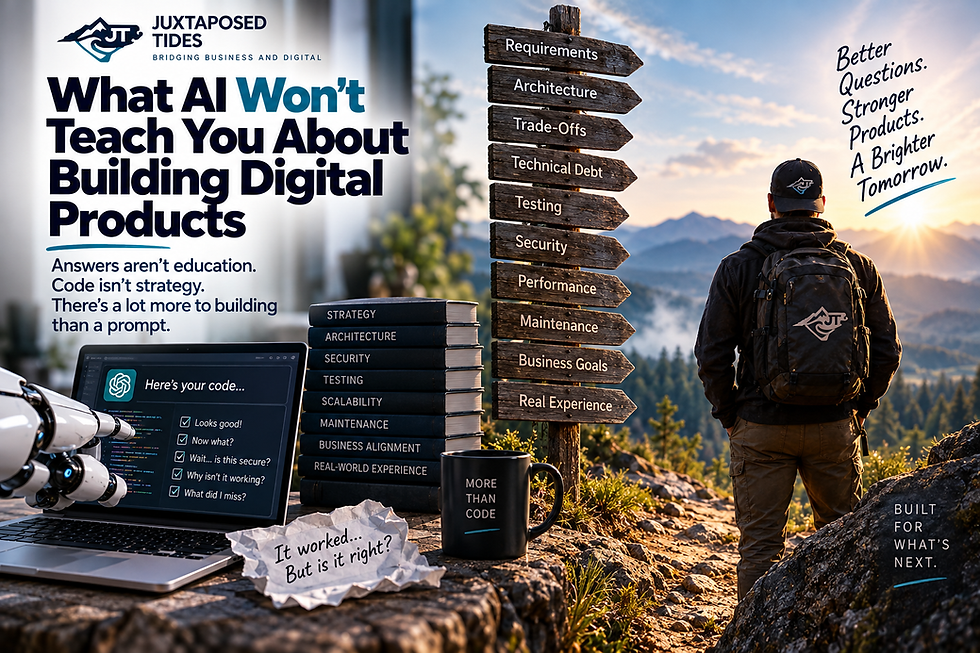
The Illusion of Education
You ask AI to build something. It generates code. You learn by doing. This is how thousands of entrepreneurs are "learning" to build digital products.
It is also how thousands are failing.
AI gives you answers. It does not give you education. It does not teach you why answers are correct, what alternatives exist, or how to evaluate trade-offs. It gives you fish without teaching you to fish—and when the fish stops coming, you starve.
This article reveals the hidden curriculum that AI cannot teach. Read it before you bet your business on what you don't know.
Lesson One: Requirements Discovery
What AI teaches: Nothing. You tell it what to build; it builds.
What you need to learn: Requirements are not what you think they are.
Requirements discovery is the art of uncovering what you actually need versus what you think you need. It involves:
Interviewing potential users about their problems
Analyzing competitors to understand market expectations
Mapping user journeys to identify friction points
Prioritizing features based on business impact
Documenting assumptions for later validation
Creating user stories that capture real needs
Building prototypes to test hypotheses
A professional requirements discovery phase takes weeks. It produces documents, diagrams, and shared understanding. It prevents building the wrong thing.
AI skips this entirely. It builds what you ask for, not what you need.
Lesson Two: Architecture Decisions
What AI teaches: Copy-paste code snippets.
What you need to learn: Architecture determines everything that follows.
Architecture decisions include:
Monolith vs. microservices
SQL vs. NoSQL databases
Server-side rendering vs. client-side rendering
REST vs. GraphQL APIs
Cloud provider selection
Authentication strategy
Caching strategy
State management approach
Testing strategy
Deployment strategy
Each decision has trade-offs. Monoliths are simpler but harder to scale. Microservices scale better but add complexity. SQL provides consistency; NoSQL provides flexibility. Server-side rendering improves SEO; client-side rendering improves interactivity.
AI cannot evaluate these trade-offs for your specific situation. It generates code based on patterns, not based on your constraints.
Lesson Three: The Art of Trade-Offs
What AI teaches: Optimal solutions for isolated problems.
What you need to learn: Real development is constant trade-offs.
Every decision involves trade-offs:
Speed vs. security
Features vs. simplicity
Customization vs. maintenance
Performance vs. development time
Scalability vs. cost
Flexibility vs. consistency
Innovation vs. reliability
The right balance depends on your business. A startup needs speed over scalability. An
enterprise needs security over features. A content site needs performance over interactivity.
AI cannot find this balance. It optimizes for the average case, which is never your case.
Lesson Four: Technical Debt Management
What AI teaches: Quick solutions that work now.
What you need to learn: Quick solutions create future costs.
Technical debt is the cost of choosing an easy solution now instead of a better solution that would take longer. Like financial debt, technical debt accrues interest. The interest is paid in:
Slower development as the codebase becomes messy
More bugs as complexity increases
Difficulty onboarding new developers
Brittleness when making changes
Inability to add certain features
Performance problems that are hard to fix
Managing technical debt requires:
Recognizing when you're incurring debt
Deciding when debt is acceptable (startups need speed)
Planning to pay it down
Refactoring systematically
Documenting debt for future developers
AI has no concept of technical debt. It generates fresh code for every problem, creating inconsistency and compounding debt.
Lesson Five: Testing Philosophy
What AI teaches: Run the code and see if it works.
What you need to learn: Testing is a mindset, not a task.
Professional testing includes:
Unit tests (testing individual functions)
Integration tests (testing component interactions)
End-to-end tests (testing complete user flows)
Performance tests (testing under load)
Security tests (testing for vulnerabilities)
Accessibility tests (testing for all users)
Usability tests (testing with real humans)
A/B tests (testing variations)
Regression tests (testing that fixes didn't break anything)
Each type requires different tools, different approaches, and different thinking. Each catches different bugs. Each requires maintenance.
AI can generate tests for code it just wrote. It cannot design a testing strategy. It cannot prioritize what to test. It cannot interpret test results in business context.
Lesson Six: Security Mindset
What AI teaches: Add authentication and call it secure.
What you need to learn: Security is a process, not a feature.
Security requires:
Threat modeling (who wants to attack you and how)
Defense in depth (multiple layers of protection)
Least privilege (give minimum access necessary)
Secure defaults (safe out of the box)
Input validation (never trust user input)
Output encoding (never trust data you output)
Encryption (protect data everywhere)
Monitoring (detect attacks in progress)
Incident response (handle breaches effectively)
Security updates (patch vulnerabilities promptly)
AI has no security mindset. It generates code that passes basic checks but fails against determined attackers. It doesn't know that your specific business makes you a target for specific attacks.
Lesson Seven: Performance Engineering
What AI teaches: Make it work, then worry about speed.
What you need to learn: Performance is architecture, not optimization.
Performance engineering involves:
Setting performance budgets (pages must load in X seconds)
Designing for performance from the start
Choosing efficient algorithms and data structures
Implementing caching at multiple levels
Optimizing database queries
Compressing and minifying assets
Lazy loading non-critical resources
Using CDNs for global delivery
Monitoring real user performance
Continuously improving
AI can suggest optimizations for existing code. It cannot design for performance from the beginning. It cannot predict which parts of your system will become bottlenecks.
Lesson Eight: Maintenance Reality
What AI teaches: Build it and you're done.
What you need to learn: Maintenance is forever.
Every digital product requires ongoing maintenance:
Security updates for dependencies
Bug fixes for discovered issues
Performance improvements as traffic grows
Feature additions as needs evolve
Platform updates (browsers change, APIs change)
Compliance updates (laws change)
Content updates
Backup verification
Monitoring and alerting
Incident response
This is not optional. It is not a one-time cost. It is the ongoing cost of having a digital product.
AI cannot help with maintenance because AI doesn't remember your code. Each maintenance task requires re-understanding the system, which you never fully understood in the first place.
Lesson Nine: Business Alignment
What AI teaches: Code that meets specifications.
What you need to learn: Code must meet business goals.
Business alignment means:
Features that drive revenue, not just exist
User experience that converts, not just functions
Performance that retains users, not just loads
Analytics that inform decisions, not just track
Costs that fit budgets, not just work
Timelines that hit market windows, not just finish
Quality that builds trust, not just passes tests
AI has no concept of business. It generates technically correct code that may be commercially useless.
Lesson Ten: The Meta-Lesson
What AI teaches: You can build anything by asking.
What you need to learn: You cannot ask for what you cannot conceive.
This is the most important lesson. You don't know what you don't know. You cannot ask AI about PCI compliance if you've never heard of PCI. You cannot ask about database indexing if you don't know what indexes are. You cannot ask about CDN configuration if you don't know what a CDN does.
The unknown unknowns are infinite. AI cannot reveal them because AI doesn't know what you don't know. Only experience can.
The Juxtaposed Tides Difference
We teach the hidden curriculum. Every project includes:
Requirements discovery workshops
Architecture design sessions
Trade-off documentation
Technical debt management
Comprehensive testing
Security by design
Performance engineering
Maintenance planning
Business alignment
You don't just get a product. You get understanding. You learn what you need to know to succeed.
The Choice
You can learn the hidden curriculum the hard way—by failing, by losing money, by watching your dream die. Thousands have taken this path. Most do not recover.
Or you can learn from those who have already failed and succeeded. You can stand on the shoulders of experts who know what AI cannot teach.
Juxtaposed Tides offers the second path. Take it.
Schedule a consultation to discuss your project and your learning goals.


Comments