
Juxtaposed Tides — Carolina’s Night Skies August 2026 Edition

August 2026: Two Eclipses, Moonless Perseids, and the Summer Sky at Full Power

August has never been known for subtlety in the Carolinas. The days arrive hot and sticky, the evenings hold onto their heat, and the night air can feel thick enough to carry. But when the clouds cooperate and the haze finally loosens its grip, August can deliver the kind of sky that makes every mosquito, late alarm, and dark-road drive worth the trouble.
And August 2026 is not playing around.
This month brings two eclipses, one of the best Perseid meteor-shower setups in years, a returning comet, a strong Mercury appearance, several Moon-and-planet encounters, and a beautifully timed New Moon that clears the stage for the Milky Way. The month ends with a nearly total-looking partial lunar eclipse that will turn most of the Full Sturgeon Moon dark, coppery, and strange.
There is something here for every kind of observer. Some events require nothing more than stepping onto the porch. Others will reward binoculars, a telescope, a camera, or a drive toward darker ground. A few will ask you to wake before sunrise. One will require proper solar protection. Nearly all of them will remind you that the Carolina sky is worth planning around.
All dates and clock times below are given in Eastern Daylight Time for North Carolina and surrounding states. Exact rise times, directions, and separation angles vary slightly across the state, so use a reliable sky app (such as PhotoPills) for your precise location.
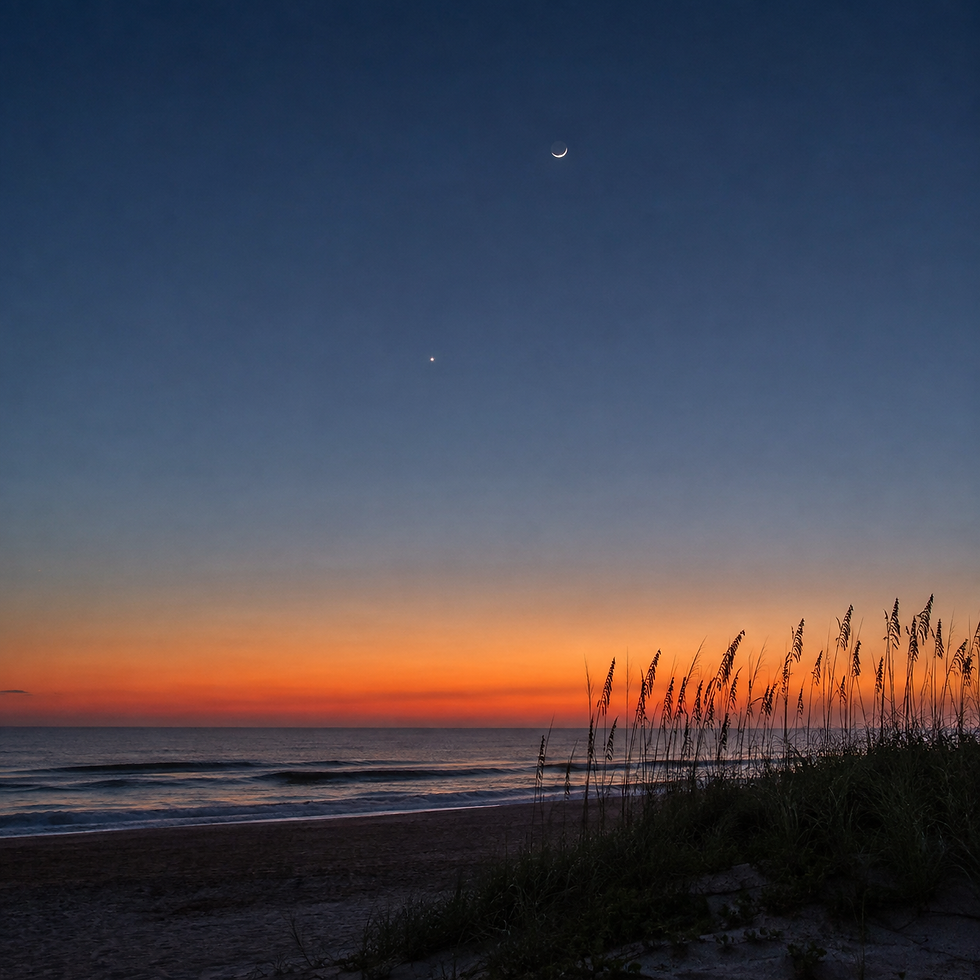
Hopefully you follow our juxtaposedtides.com/night-skies page so you can capture moments like our team did here, for last month's full Buck moon!

TL;DR:
August 2026 Night Skies — The Simple Version
August 2 — Mercury at its morning best: Look low toward the east-northeast before sunrise. A clear horizon is essential, and binoculars may help while the Sun remains safely below the horizon.
August 2–3 — Comet 10P/Tempel 2: This faint returning comet may be visible through binoculars or a small telescope from a dark location. Use a current sky chart to find it.
August 4 — Moon near Saturn: Look east to southeast before dawn for the waning Moon beside steady, golden Saturn. A small telescope will reveal Saturn’s thin-looking rings and excellent lunar crater detail.
August 8–15 — Prime Milky Way window: These are the darkest evenings of the month. Find a dark location with a clear southern horizon to see or photograph the Milky Way core.
August 12 — Tiny partial solar eclipse in northeastern NC: Currituck County and parts of the northern Outer Banks may see a very small notch taken from the Sun between roughly 1:31 and 2:27 PM EDT. The sky will not noticeably darken. Certified eclipse glasses are required at all times.
August 12–13 — Perseid Meteor Shower peak: The Perseids arrive under a New Moon, giving North Carolina beautifully dark viewing conditions. Watch from late evening through dawn, with the strongest activity generally after midnight.
August 14–15 — Venus at its evening best: Brilliant Venus reaches its greatest evening separation from the Sun and remains easy to spot in the western sky after sunset.
August 15 — Mercury meets Jupiter: The smallest and largest planets appear extremely close together low in the eastern dawn. This is a challenging horizon event, so binoculars and perfect timing will help.
August 16 — Crescent Moon near Venus: Look west after sunset for one of the month’s easiest and most photogenic pairings—a young crescent Moon beside dazzling Venus.
August 27–28 — Deep partial lunar eclipse: Nearly the entire Full Sturgeon Moon enters Earth’s dark shadow. The visible partial phase begins around 10:33 PM EDT, with maximum eclipse near 12:12 AM. No special eye protection is needed.
Best overall nights: August 8–15 for the Milky Way, August 12–13 for the moonless Perseids, August 16 for the Moon and Venus, and August 27–28 for the eclipsed Full Sturgeon Moon.
August 2: Mercury Makes Its Best Morning Move
Mercury begins the month by giving Carolina observers one of their better chances to find the Solar System’s smallest planet.
On August 2, Mercury reaches greatest western elongation, placing it about 19.5 degrees west of the Sun in our sky. In plain English, that means Mercury gets about as far from the sunrise glare as it will during this particular morning appearance.
Look low toward the east-northeast before sunrise. The most useful window will generally fall between about an hour and 90 minutes before the Sun comes up, although the exact timing depends on where you are in North Carolina and how open your horizon is.
Mercury will not look dramatic. It will resemble a modest point of light sitting low in the brightening dawn. A clear horizon matters more than a dark observing site, and binoculars can help you find it through haze—but remember to put them down well before sunrise. Never sweep around the rising Sun with binoculars or a telescope.
The coast offers the cleanest horizon, but morning humidity may soften the view. Inland observers should look for an open field, lake, ridge, or elevated road with a clear eastern outlook. Mercury does not stay conveniently placed for long, so treat this as an early-month target rather than something to postpone.
August 2–3: Comet 10P/Tempel 2 Comes Around Again
While Mercury works the dawn horizon, a returning comet reaches the most favorable part of its 2026 visit.
Comet 10P/Tempel 2 reaches perihelion—its closest point to the Sun—on August 2, then makes its closest approach to Earth on August 3 at roughly 0.414 astronomical unit away. Forecasts have placed it around magnitude 8 to 10 near its best, but comet brightness is famously unpredictable. It may become a binocular target beneath excellent skies, although a small telescope or tracked camera will provide a more realistic chance of finding it.
This is not a naked-eye spectacle, and it should not be presented as one. Tempel 2 will look more like a faint, diffuse smudge than the bright, tailed comet people often imagine. The reward is in finding it at all.
From the Carolinas, the comet will be best pursued from late evening into the early-morning hours, when it climbs through the southern part of the sky. Use a current finder chart rather than trying to locate it from a written description alone; comets move against the background stars, and an accurate chart will save a great deal of frustration.
The bright waning Moon at the beginning of August will not help. Observers may get a cleaner look later in the first half of the month as evening skies darken, although the comet will gradually begin fading after its early-August peak.
Tempel 2 is not the month’s easiest target. It is the month’s good challenge.
August 4: The Waning Moon Passes Saturn Before Dawn
Before sunrise on August 4, the waning gibbous Moon passes near Saturn in the eastern-to-southeastern sky.
This is a morning event—not an early-evening one. Saturn rises late in the evening and becomes better placed as the night progresses, while the Moon travels near it before dawn. The two will not be touching-close, but they will be near enough to form an obvious pairing and help beginners identify the ringed planet.
Saturn will look like a steady, yellowish point of light. Unlike a star, it should not twinkle strongly when the atmosphere is calm. Through a small telescope, its rings remain visible, although their unusually narrow presentation in 2026 makes them look thinner than the broad, open rings many observers remember.
The Moon will also be near its Last Quarter phase, which is an excellent time to examine lunar terrain. Along the terminator—the boundary between lunar daylight and darkness—craters, ridges, and mountains cast long shadows that make the surface appear dramatically three-dimensional.
A telescope can show both worlds beautifully, but not usually at the same magnification. Begin with a low-power view to enjoy the setting, then increase magnification for the Moon’s terrain and Saturn’s rings.

August 5–16: The Summer Sky Finally Goes Dark
The first half of August delivers the month’s best extended dark-sky window.
The Moon reaches Last Quarter late on the evening of August 5 in North Carolina, then continues shrinking into the morning sky. Each night after that leaves more of the evening free from moonlight. By August 8 or 9, the early night becomes substantially darker, and the stretch surrounding the August 12 New Moon offers the cleanest conditions of the month.
This is prime Milky Way time.
From a dark Carolina site, the bright central region of our galaxy stretches through the southern sky, rising out of Sagittarius and climbing through the rich star fields of summer. The Milky Way does not look like the hyper-saturated photographs found online. To the unaided eye, it appears as a pale, textured band—almost like a thin cloud that refuses to move.
Give your eyes at least 20 to 30 minutes away from white light. Once they adapt, dark rifts and denser star clouds begin separating from the background. Binoculars transform the same region into a field packed with stars, clusters, and nebulae.
For photography, the nights from roughly August 8 through August 15 are the ones to protect. The exact best hours shift nightly, but the galactic core is generally well placed from late evening into the first part of the night. A wide lens, sturdy tripod, remote shutter, and a truly dark southern horizon matter more than chasing extreme camera settings.
Western North Carolina offers some of the darkest skies in the region, particularly where elevation lifts observers above lowland haze. Coastal locations offer a different advantage: an unobstructed southern horizon over the Atlantic or a broad sound. Rural Piedmont sites can also work well when they are positioned away from the light domes of Charlotte, the Triad, the Triangle, and other growing population centers.
The location does not have to be famous. It has to be dark, safe, legal, and pointed the right way.
August 8–11: The Moon Walks Through the Morning Planets
The predawn sky becomes increasingly busy from August 8 through August 11 as the waning crescent Moon passes through a field containing Mars, Mercury, and very low Jupiter.
Calling this a “tight planet parade” can give the wrong impression. The objects will not all be packed into one tiny cluster. Instead, they trace the same general path along the ecliptic, creating a slanted progression across the eastern morning sky.
Mars is the easiest colored target, glowing with a warm orange-red tone. Mercury remains low and increasingly difficult as it begins heading back toward the Sun. Jupiter is returning from solar conjunction and may be very low in bright twilight, making it the most horizon-dependent member of the display.
The Moon becomes the guide. On successive mornings, watch it move eastward through the scene, thinning into a delicate crescent and displaying Earthshine across its night side. Around August 9–10, it appears near Mars. By August 11, the extremely thin crescent approaches Mercury, with Jupiter much lower in the glow.
This is a case where a clear horizon and disciplined timing matter more than darkness. Begin early enough to find the objects before twilight strengthens, but stop using binoculars before the Sun approaches the horizon.
For photographers, the changing arrangement offers several mornings of possible compositions rather than one make-or-break date. A longer lens can compress the Moon and planets above a distant ridge, while a wider lens can include the returning winter stars beginning to appear in the August dawn.
August 12: A Total Solar Eclipse Elsewhere—and a Tiny Partial View from Northeastern North Carolina
On August 12, a total solar eclipse crosses parts of the Arctic, Greenland, Iceland, the Atlantic, and northern Spain. North Carolina is nowhere near the path of totality.
However, the far northeastern edge of the state clips the outermost boundary of the partial eclipse. Currituck County and portions of the northern Outer Banks receive the best North Carolina view, although “best” needs to be understood honestly: this will be a very small partial eclipse.
For Currituck, the approximate local circumstances are:
Partial eclipse begins: 1:31 PM EDT
Maximum eclipse: 1:59 PM EDT
Partial eclipse ends: 2:27 PM EDT
At maximum, the eclipse magnitude is only about 0.061. That means the Moon will take a thin notch from the Sun’s edge. The sky will not noticeably darken. Temperatures will not suddenly drop. Shadows will not become dramatically strange. Without safe solar viewing equipment, most people would never know it was happening.
Visibility decreases quickly as you travel southwest. Much of North Carolina receives an even smaller event or misses it entirely, so observers should check their precise location before making plans.
Certified eclipse glasses must remain over your eyes whenever you look at the Sun.
Regular sunglasses are not safe. Cameras, binoculars, and telescopes require properly fitted solar filters placed over the front of the instrument; eclipse glasses worn behind magnifying optics are not sufficient and can lead to severe eye injury.
This is not the Carolina eclipse of a lifetime. It is a tiny local brush with a major eclipse happening elsewhere—and an opportunity to practice safe solar observing.
August 12–13: The Perseids Get the Moonless Sky They Deserve
Once the Sun goes down and the solar eclipse is over, August 12 transitions into the biggest nighttime event of the month: the Perseid meteor shower.
The Perseids are active for weeks, but their broad traditional maximum falls from the evening of August 12 into the morning of August 13. In 2026, the peak arrives under a New Moon. That is nearly ideal.
No bright lunar glare will be bleaching the sky. No moonset calculation is required. If clouds stay away, the darkness will belong to the meteors.
The International Meteor Organization gives the Perseids an idealized zenithal hourly rate near 100. That figure assumes a perfectly dark sky, a radiant directly overhead, and an observer with an unobstructed view. Real-world counts are usually lower. From a genuinely dark Carolina location, seeing dozens of Perseids per hour is a reasonable hope during the stronger stretches, while suburbs and cities will reveal far fewer.
The radiant in Perseus becomes usefully high by roughly 10 or 11 PM and continues climbing through the night. The viewing generally improves after midnight, with the predawn hours offering the highest radiant and the greatest likelihood of strong activity.
You do not need to stare directly at Perseus. Meteors can appear anywhere. In fact, the longest streaks often show up farther from the radiant.
Find a dark location with a broad view of the sky. Recline rather than craning your neck. Keep phones dimmed and red-filtered. Give your eyes time to adapt. Bring water, bug spray, and more patience than you think you need.
For photographers, use a wide, fast lens and frame a strong foreground rather than filling the image with empty sky. Run repeated exposures or a time-lapse sequence. Aim away from major light pollution and avoid constantly changing the camera after every blank frame. Meteor photography is partly preparation and partly luck.
This year, at least, the Moon is not working against you.
August 14–15: Venus Stretches Farther into the Evening
Around the evenings of August 14 and 15, Venus reaches greatest eastern elongation, its greatest apparent separation from the Sun during this evening appearance.
That does not mean Venus reaches the top of the sky. It means it remains visible longer after sunset and is especially well placed in the western evening twilight.
Venus is impossible to confuse with an ordinary star once you notice it. It shines with a hard, brilliant light and becomes visible before most other celestial objects. Through a telescope, it shows a phase rather than a fully illuminated disk, much like a miniature version of the Moon.
This is one of those events that matters less as a one-night spectacle and more as the high point of a longer observing season. Venus will continue to be a dominant evening object, but mid-August marks the geometry that lets it stand farthest from the Sun in our sky.
For photographers, use it as a bright anchor above familiar Carolina landscapes. The most effective images will include something grounded: marsh grass, a ridge, a steeple, a pier, a lone tree, or a line of pines against the remaining sunset color.

August 15: Mercury and Jupiter Squeeze Together Before Sunrise
Before sunrise on August 15, Mercury and Jupiter pass just over half a degree apart—close enough to fit together within a small telescopic field and roughly the apparent width of the Full Moon.
This is an intriguing pairing: the Solar System’s smallest planet beside its largest.
It is also a difficult one.
Both planets sit low in the eastern dawn, and Mercury is already sinking back toward the Sun. Jupiter is brighter, but atmospheric haze and twilight can erase even a bright planet when it is close to the horizon.
Use Jupiter as the starting point, then search close beside it for Mercury. Binoculars may help, but only while the Sun remains safely below the horizon. A flat eastern view over water, open farmland, or a distant low ridge gives you the best chance.
The conjunction is geometrically impressive even if the viewing conditions are not generous. This is one for determined early risers, not a guaranteed crowd-pleaser.
August 16: The Crescent Moon Finds Venus
The evening of August 16 gives us one of August’s easiest and most photogenic alignments.
A young waxing crescent Moon appears near brilliant Venus in the western twilight. The two are separated by only a few degrees, forming an obvious pairing visible without any equipment.
Unlike the Mercury–Jupiter conjunction the morning before, this event gives observers more room to breathe. Venus is bright. The Moon is unmistakable. The timing falls after sunset rather than before dawn.
The main challenge is the horizon. Both objects remain in the western part of the sky, so trees, buildings, and mountains can shorten the viewing window. Scout the location before sunset rather than discovering too late that a tree line blocks the entire scene.
Watch for Earthshine on the Moon’s dark side. A camera may record it even when the eye sees only a hint. A wide landscape frame can include the twilight colors, while a telephoto lens can isolate the Moon and Venus together.
Not every good night-sky image needs a meteor, eclipse, or giant telescope. Sometimes a crescent Moon and a brilliant planet are enough.
August 27–28: The Full Sturgeon Moon Enters Earth’s Shadow
August saves its most dramatic lunar event for the end.
On the night of August 27 into the early morning of August 28, North Carolina will see a deep partial lunar eclipse. Earth’s dark umbral shadow will cover nearly the entire Moon, producing an eclipse magnitude of about 0.930. Only a narrow bright portion remains outside the deepest shadow at maximum.
This is technically a partial eclipse, not a total “Blood Moon.” But because so much of the
Moon enters the umbra, the event may look remarkably close to totality. Most of the lunar disk can take on shades of rust, copper, brick red, brown, or charcoal, while the uneclipsed sliver remains strikingly bright.
The exact color cannot be guaranteed. It depends partly on the condition of Earth’s atmosphere. Dust, clouds, smoke, and aerosols around the planet affect how much red sunlight bends into the shadow.
For Charlotte and much of central North Carolina, the approximate timeline is:
9:23 PM, August 27: Penumbral eclipse begins10:33 PM: Partial eclipse begins12:12 AM, August 28: Maximum eclipse1:51 AM: Partial eclipse ends3:01 AM: Penumbral eclipse ends
Times vary by a few minutes across the state, but the overall event is visible throughout North Carolina.
The earliest penumbral shading will be subtle. Do not expect a sharp bite at 9:23. The visible drama begins after 10:33, when the umbra starts moving across the Moon. By maximum at 12:12 AM, nearly the entire disk will be immersed in deep shadow.
No special eye protection is needed for a lunar eclipse. Binoculars make the changing colors more obvious, while even a small telescope can reveal the curved edge of Earth’s shadow crossing crater fields and lunar seas.
Photographers should prepare for a major exposure change. The uneclipsed Full Moon is extremely bright; the deeply eclipsed Moon is dramatically dimmer. Settings that work before the eclipse will not work at maximum. Use a tripod, shoot manually, review highlights carefully, and be ready to increase ISO or lengthen the exposure as the Moon darkens.
Why This Sturgeon Moon Is Different
The Moon reaches exact fullness at about 12:18 AM EDT on August 28—only minutes after the eclipse reaches maximum.
That timing creates the defining image of the month: a Full Sturgeon Moon almost completely swallowed by Earth’s shadow.
A normal Full Moon floods the landscape with light and washes away faint stars. During this eclipse, much of that glare disappears. As the Moon darkens, more stars become visible around it, and the whole sky briefly changes character.
The term “Sturgeon Moon” is a traditional seasonal name associated with the late-summer period when sturgeon were historically more readily caught in parts of the Great Lakes and other North American waters. The name does not describe the Moon’s color. The eclipse is what may turn it red.
This is the night to bring someone outside who claims the Moon always looks the same.
August 2026 Moon Phases—Corrected for North Carolina Time
Published Moon-phase calendars often list dates in Universal Time, which can shift a phase onto the previous calendar date in North Carolina. For local EDT planning, the major phases occur as follows:
Last Quarter: August 5 at 10:21 PM EDT
New Moon: August 12 at 1:37 PM EDT
First Quarter: August 19 at 10:46 PM EDT
Full Sturgeon Moon: August 28 at 12:18 AM EDT
That sequence explains the shape of the month beautifully. Moonlight declines just in time for the Milky Way and disappears for the Perseid peak. The Moon then grows through the evening sky before reaching fullness precisely as it enters Earth’s shadow.

The Carolina Game Plan
August skywatching in North Carolina is often less about finding the event and more about outmaneuvering the weather.
Humidity can blur the horizon. Afternoon thunderstorms can leave lingering cloud decks. Dew can coat lenses. Mosquitoes can make a carefully planned observing session feel like a blood donation.
Check cloud cover, transparency, and dew point—not just the rain forecast. A technically clear sky can still be too hazy for the Milky Way, Mercury, or faint comet hunting. Nights following a cold front tend to offer the cleanest summer transparency.
For the Milky Way and Perseids, prioritize darkness and an open sky. Mountain sites often offer stronger contrast and lower light pollution, while the Outer Banks and quieter coastal stretches provide enormous horizons. Rural areas between the major Piedmont cities can work well without requiring an all-night expedition.
For the August 12 partial solar eclipse, northeastern North Carolina is the only part of the state with a meaningful chance of seeing even the tiny partial phase. Currituck County and the northern Outer Banks are the practical focus.
For the lunar eclipse, nearly anywhere with a clear sky will work. The Moon will climb from the east-southeast toward the southern sky as the event progresses. A backyard, field, lake, beach, or ordinary neighborhood can deliver the full experience.
For the Perseids, get away from streetlights. For Venus and the crescent Moon, find a western horizon. For morning planets, face east. Match the site to the target instead of assuming one observing location works for everything.
Why August 2026 Matters
August usually gives Carolina observers one major headline: the Perseids.
This year, the month refuses to stop there.
We get Mercury at dawn, a binocular comet, a Moon–Saturn morning, a long Milky Way window, a rare sliver of a solar eclipse in northeastern North Carolina, moonless Perseids, Venus at its evening best, two close planetary encounters, and a Full Sturgeon Moon nearly consumed by Earth’s shadow.
Some of those events are easy. Some are subtle. A few require real effort.
Together, they make August 2026 one of the most complete observing months of the year.
Final Thought
August has always asked a little more of Carolina skywatchers.
It asks us to stay awake through the humidity. To watch forecasts that change by the hour. To drive beyond the city glow. To keep the bug spray close and the expectations flexible.
But this August gives plenty back.
It gives us meteors in a moonless sky. A Milky Way stretching over summer landscapes. Planets gathered in twilight. A tiny eclipse most of the state will barely touch. And, at the end, a Full Moon turning dark and copper-red while Earth’s shadow moves across it.
You do not have to see everything.
Choose one dawn. One moonless night. One eclipse.
Then step outside and let the sky make the rest of the argument.
Clear skies, Carolina. See you beneath the August stars.
Juxtaposed Tides — Carolina’s Night Skiesjuxtaposedtides.com/nightskies


Comments