
JT Chasing Americas 250th: Halifax Resolves Day: Historical Significance and Modern Commemoration 2026

Updated: Apr 16


We got up early the morning of April 11, 2026 bright eyed and bushy tailed, and ready for a day of Revolutionary celebration. We had to pack and peal out early for the 3 hour drive ahead, and to hopefully beat some of that infamous Raleigh traffic. The drive was smooth as hand-shaken butter.

As soon as we entered Halifax, something felt different. The air changed; it was imbued with history, and it truly felt... American. We could instantly tell that this small town cherished its historical significance to our country, especially with the evident effort put into celebrating the 250th anniversary of the events that established and built the United States of America.

And what a lovely time of year for our great fore-fathers and statesmen to have met here near the coast of North Carolina, for the trees, flowers and everything alive was blooming with great anticipation for the year to come. With excited legs and a revolutionized spirit, we strolled the long, long walk into the historic area where the streets were closed off. We had this long walk by choice and not by choice, since there w ere so many visitors present to see the Halifax Resolves Day Reenactment.


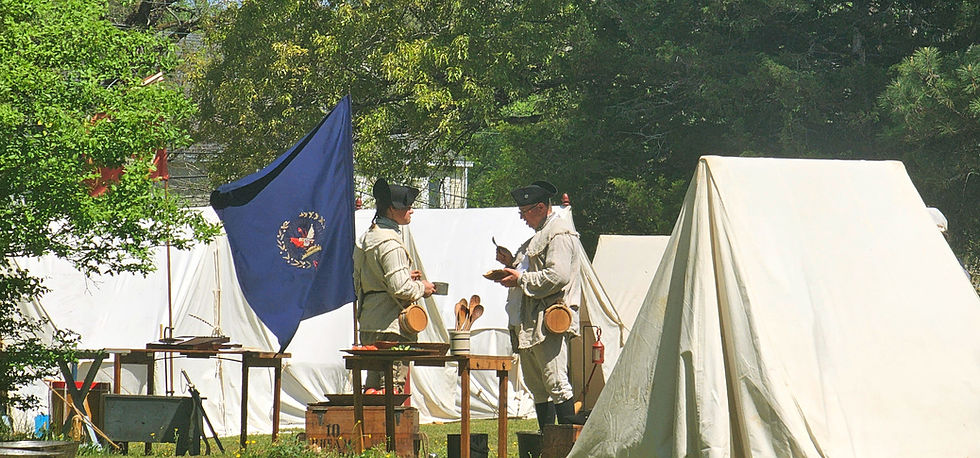


Here is how Juxtaposed Tides team member Al expresses the day of commemoration through her personal lens: "The small town of Halifax is an inspiration; it has managed to keep the Revolutionary energy alive in the acreage it spans - even amongst the highways and development that surrounds it now - exactly 250 years after its vital role in the American Revolution.
Our recent visit there for the reenactment happened on a day that was perfectly hot and equally beautiful. Spring had the pollen a-swirl and its color-popping producers in bloom, creating a yellow-green powdering on all boots and shoes walking. The rows of tents had a nice dusting as well, much like it probably would have been 250 years ago.
Under massive trees who may have borne witness to the actual events, the Suttlers were spread offering their period-authentic wares and services. Just out from the rows where soldiers’ quarters were set up stretched a long, narrow field used for artillery exhibitions. Reenact-ors formed lines, loaded muskets and cannons, and blasted powder for the delight (and dismay to some ears!!) of the strong numbered crowd gathered to get a glimpse of a Revolution passed. Soldiers welcomed us into their “world” and chatted at length of the times and life they were inhabiting.
We were regaled by one young man in [mountain man garb] who deftly explained the role that a group called “the Regulators” played in the war. There were some interesting tidbits I had never heard and these new insights I plan to look into further as the year rolls on.
Another knowledgeable gentleman welcomed us to his campsite and shed deep light onto the art and stresses of the recruitment process during such tenuous times. These encounters gave us plenty of new food for thought, which is why these adventures are on our calendar.
The crowd then gathered for the brilliant replay of the NC Resolves - debates among men in leadership from the colony of North Carolina, each expressing their two-cents prior to a unanimous delegation vote of “AYE!” This was the word that joined us in the quest to emerge as a united America so we could procure our freedom from Great Britain.
There was a triumphant and electrically reverent vibe as members of the watching audience acted as the delegates and proudly shouted their “Aye!!!” with the calling of their character’s name. What an experience!!
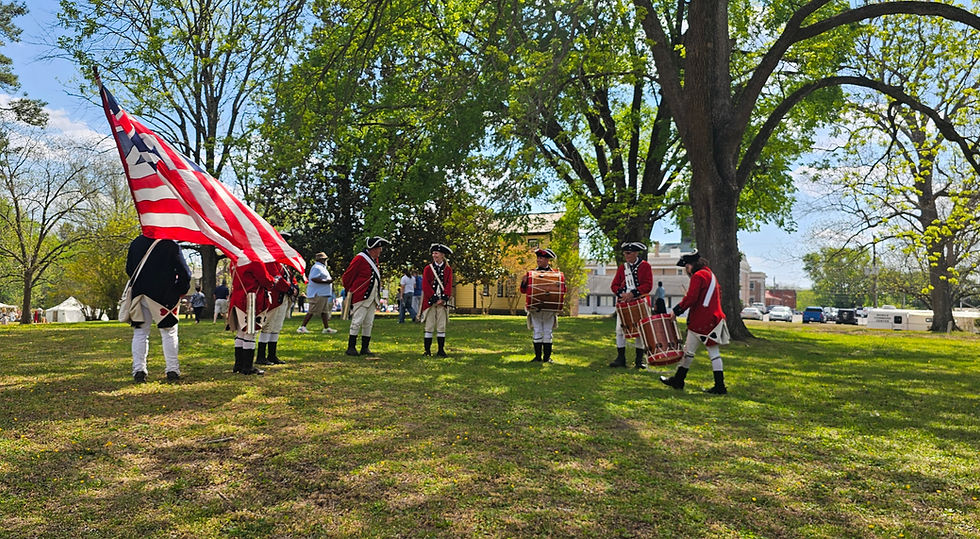
Following the reenactment of the Resolves of NC - under the shade of twisted and glorious old-growth trees - the Fife and Drum Corps of New Bern took us out with several vigorous tunes. The harmonious notes traveled the breeze and the spot-on percussion moved the bones. The group was spectacular!!
It spurred us on to the authentic tavern-turned-museum where we learned of the hub that Halifax was for weary wayfarers and war-tired military men. The nearby African-American Revolutionary museum was alive with exhibits and an energetic display of life in an era of such uncertainty and courage.
Our final stop for the day was at the Catholic Church just down the road from the Market Square of Halifax. All original furnishings and glass, even an old pump organ, wowed us to quietude as the kind docent shared of the origins of the church and Catholicism in the colony. She insisted we break the worshipful spell and ring the ol’ bell, the first hung there in the tower - and still sounding - a grande way to end a day in such a crucial and historic North Carolina town."




Historical Context
Halifax Resolves Day, observed annually on April 12, marks a pivotal moment in American history: the adoption of the Halifax Resolves in 1776.
On this date, in Halifax, North Carolina, the Fourth Provincial Congress formally authorized North Carolina’s delegates to the Continental Congress to support independence from Great Britain. This was the first official action by any American colony calling for independence, setting a critical precedent for what would follow in July 1776.
The Resolves emerged from a period of escalating tension between the colonies and British authority. Policies such as taxation without representation and punitive measures against colonial resistance had intensified unrest. Armed conflict had already begun, and momentum toward independence was building.
The Halifax Resolves did not declare independence outright. Instead, they empowered North Carolina’s representatives to join with other colonies in pursuing it. They also reaffirmed the colony’s commitment to the war effort, including providing troops, supplies, and support against British forces.
This action helped push the broader colonial movement toward a unified decision, ultimately contributing to the adoption of the Declaration of Independence later that year.
Significance of the Halifax Resolves
The Halifax Resolves represent a turning point in the movement toward American independence.
They demonstrate that the desire for independence was not sudden or isolated, but the result of growing conviction across the colonies. North Carolina’s action helped legitimize the idea of independence at the governmental level, not just among individuals or local groups.
The Resolves are often regarded as one of the earliest formal expressions of American self-governance, reinforcing the principle that authority derives from the people rather than a distant monarchy.
Halifax itself became an important historical site because of this decision, representing a place where uncertainty gave way to action.
Modern Commemoration: Halifax Resolves Day
Today, Halifax Resolves Day is commemorated through events that reflect both the historical moment and its lasting impact.
The North Carolina Department of Natural and Cultural Resources, along with Historic Halifax State Historic Site, organizes annual programming that includes:
Living History Demonstrations
Reenactors interpret the lives of soldiers, civilians, and political figures, offering a grounded view of daily life and decision-making during the Revolutionary period.
Educational Programs and Lectures
Historians and scholars present discussions on the broader Revolutionary context, with particular attention to North Carolina’s role and the importance of the Resolves.
Colonial Music and Cultural Programming
Period-appropriate music and dance provide cultural context, helping illustrate the environment in which these events unfolded.
Military Demonstrations
Reenactments of tactics, formations, and weaponry offer insight into the realities faced by both militia and Continental forces.
Community Events
Public gatherings, local participation, and shared experiences reinforce the connection between past and present.
Historic Site Tours
Guided tours of Halifax and the Visitor Center provide deeper
understanding of the location, the people involved, and the significance of the decisions made there.
For the 250th anniversary in 2026, these commemorations have been expanded into multi-day events, emphasizing both historical accuracy and public engagement.
Cultural Impact and Legacy
The influence of the Halifax Resolves extends beyond North Carolina.
They contributed to the broader shift toward independence and remain part of the foundational narrative of the United States. The principles reflected in the Resolves—self-governance, accountability, and collective action—continue to resonate throughout American history.
Halifax Resolves Day serves as both a remembrance and a point of reflection. It highlights the risks taken by those who supported independence and the uncertainty they faced in doing so.
Conclusion
Halifax Resolves Day is not simply a historical observance. It marks a moment when a colony moved from resistance to decision.
It represents a step toward independence taken without guarantees, under conditions of uncertainty, and with full awareness of the risks involved.
As the United States approaches its 250th anniversary, the Resolves remain a clear reminder that independence was not inevitable. It was chosen. It was well thought-out and debated heavily by great minds and a thoughtful people.
Be sure to follow as @JuxtaposedTides, as well celebrate fellow Americans during this great year commemorating our 250th year as an independent nation under God, indivisible, with liberty and justice for all.
Thanks for reading!


I love my patriotic Grandchildern. I couldn't ask for 2 better kids to call me Granny