
BEFORE YOU BURN THE BOAT: A Letter to Everyone Who Hates Their Job and Thinks Entrepreneurship Will Set Them Free


The 2:47 AM Feeling
It's 2:47 AM. You're lying awake, staring at the ceiling, and you feel it.
That weight.
That heaviness in your chest that comes from another day spent building someone else's dream. Another day answering to someone who doesn't see you. Another day trading your hours for their profit. Another day of pretending that this is enough, that this is fine, that this is what you signed up for.
You think about tomorrow. The same commute. The same desk. The same meetings that could have been emails. The same fluorescent lights that make everyone look slightly ill. The same boss who takes credit for your work. The same feeling of your soul slowly calcifying.
And then you think about the alternative.
Your own thing. Your own hours. Your own ideas. Your own profit. No boss. No commute. No fluorescent lights. Just you, your vision, and the open road of possibility.
It feels like freedom. It feels like salvation. It feels like the answer to every frustration, every limitation, every dream deferred.
I get it. I really do.
I've been there. I've felt that 2:47 AM weight. I've fantasized about walking out and never looking back. I've imagined the moment I'd tell my boss exactly what I thought of them and their company and their fluorescent lights. (And eventually, that is just what I did...).
But here's what I also know, and here's what you need to hear before you do anything drastic:
That feeling is not a business plan. That fantasy is not a strategy. That dream of freedom is not the same as the reality of entrepreneurship.
And if you act on that feeling without understanding what you're actually getting into, you won't find freedom. You'll find something much worse than your current job. You'll find a new kind of prison, one built by your own hands, with bars made of debt and desperation.
This article is long. It's detailed. It's probably not what you want to hear right now, when you're feeling that 2:47 AM fire. But read it anyway. Read it before you do anything. Read it before you quit. Read it before you burn the boat.
Because once that boat is burning, there's no going back.
PART ONE: THE IDEA OF VS. THE REALITY OF
Let's start with the most dangerous phrase in entrepreneurship:
"I love the idea of..."
I love the idea of being my own boss.
I love the idea of setting my own hours.
I love the idea of working from anywhere.
I love the idea of building something that's mine.
I love the idea of financial freedom.
I love the idea of never answering to anyone again.
These are beautiful ideas. They're also completely disconnected from reality.
The idea of being your own boss is wonderful. The reality is that you now have multiple bosses: every single customer, every single client, every single vendor, every single platform that can change its terms overnight, every single algorithm that can tank your traffic with no warning. You have more bosses than you ever did in corporate, and none of them care about your feelings.
The idea of setting your own hours is wonderful. The reality is that you now work all the hours. Evenings, weekends, holidays, sick days, vacation days. There is no off switch. There is no "not my problem." There is only you and the endless list of things that need to be done, and they all need to be done by you because you are the entire company.
The idea of working from anywhere is wonderful. The reality is that you work from a spare bedroom that's too cold in winter and too hot in summer, from coffee shops where you have to buy something every hour, from your dining room table that's also where you eat dinner, from your car between client meetings. And everywhere you work, you're alone.
The idea of building something that's mine is wonderful. The reality is that you're building
something that owns you. It demands everything. Your time, your energy, your attention, your savings, your relationships, your health. It asks for more than you have and then asks for more.
The idea of financial freedom is wonderful. The reality is that for the first year, probably longer, you will make less than you made at your job. Much less. You will watch your savings dwindle while you work harder than you've ever worked. You will lie awake at 3 AM doing math that doesn't work, wondering how you'll make rent.
The idea of never answering to anyone again is wonderful. The reality is that you answer to everyone. Every client who's unhappy. Every customer who's confused. Every platform that changes its rules. Every algorithm that stops showing your content. Every bank that freezes your account. Every tax authority that wants its money. You answer to more people than you ever did, and they're all harder to please than any boss ever was.
This is not to say entrepreneurship is bad. It's not. It can be wonderful. It can be the best decision you ever make.
But you need to be in love with the reality, not just the idea. You need to want the 80-hour weeks, not just the freedom. You need to want the uncertainty, not just the upside. You need to want the loneliness, not just the autonomy. You need to want the struggle, not just the success.
Because the success, if it comes, comes after years of struggle. The freedom, if it comes, comes after years of captivity to your business. The financial freedom, if it comes, comes after years of eating ramen and watching your savings disappear.
Are you in love with that? Really?
PART TWO: THE MATH THEY DON'T TEACH YOU
Let's talk about money. Specifically, let's talk about the math of going out on your own (not the dream or idea of making millions...).
You make $24 an hour at your job. After taxes, insurance, and that little 401k contribution, you take home maybe $18. It's not great, but it's consistent. Every two weeks, like clockwork, money appears in your account. You can plan. You can budget. You can sleep.
Now you're going out on your own. You're going to charge $75 an hour. That's more than three times your hourly rate. You feel like you're moving up in the world.
Let's do the real math.
First: Billable hours.
You cannot bill forty hours a week. It's impossible. Part of your time will be spent on non-billable work: marketing, accounting, sales, emails, proposals, invoicing, follow-ups, learning, networking, fixing things that break, dealing with problems that have nothing to do with the work you actually get paid for.
A realistic billable rate for a solopreneur is twenty to twenty-five hours per week. The rest is overhead.
At twenty-five billable hours per week, at $75 per hour, you gross $1,875 per week. Sounds decent.
Second: Taxes.
You remember how your job took taxes out before you ever saw the money? That's over.
Now you're the one who has to save and pay.
Self-employment tax is 15.3% right off the top. That's FICA, both the employee and employer portions, because you're now both.
Then there's federal income tax. Then state income tax, if your state has it.
Set aside 30% to 35% of everything you make for taxes. If you don't, you will have a very bad April.
That $1,875 per week just became $1,218 after taxes.
Third: Expenses.
You need health insurance. Remember that little deduction from your paycheck? That was your share. Your employer was paying the rest. Now you pay all of it.
For a decent plan, expect $500 to $1,000 per month, minimum. More if you have a family.
That's $125 to $250 per week.
You need equipment. Laptop, phone, software, subscriptions. Another $100 per week, easily.
You need internet, phone, maybe a co-working space if you can't stand being alone all day.
Another $50 per week.
You need professional services. Accountant, lawyer, maybe a coach or consultant. Another $50 per week averaged out.
You need to save for retirement. You don't have a 401k with match anymore. You have to fund your own IRA or Solo 401k. Another $100 per week if you're smart.
Add it up: $500 per week in expenses, minimum.
That $1,218 after taxes is now $718 per week.
Fourth: The Gap.
$718 per week is $37,336 per year.
At your job, after taxes and deductions, you were taking home $18 per hour times forty hours times fifty weeks, which is $36,000 per year.
You just did all this work, took all this risk, endured all this uncertainty, and you're making almost exactly the same money.
Except at your job, you had paid time off. You had sick days. You had holidays. You had health insurance subsidized. You had a 401k match. You had colleagues. You had a predictable schedule. You had weekends.
Now you have none of that, and you're making the same money.
And this assumes everything goes well. This assumes you always have clients. This assumes you always get paid on time. This assumes nothing breaks. This assumes no dry spells. This assumes no emergencies.
This is the math they don't teach you.
$75 an hour sounds like a raise. It's not. It's survival wages, once you account for everything.
To actually make more than your job, you need to charge more than $75. Much more. Or you need to work more than twenty-five billable hours, which means working seventy total hours, which means no life, no rest, no boundaries.
This is the reality of solopreneurship.
PART THREE: THE EXPANDED MATH OF ACTUALLY MAKING IT
Let's go deeper, because the math above is just the beginning.
The Reality of Inconsistent Income
At your job, money arrives every two weeks like clockwork. You can set up automatic bill payments. You can budget. You can relax.
In your own business, money arrives when it arrives. Maybe a client pays in fifteen days. Maybe they pay in sixty. Maybe they don't pay at all, and you have to chase them, and then they pay in ninety, and by then you've already had to borrow money to cover your rent.
You will have months with $10,000 in revenue. You will have months with $500. You will have to learn to smooth this out, to save in the good months to survive the bad months, to never quite know when the next check is coming.
This uncertainty is not theoretical. It is a constant, grinding stress that never goes away. It follows you to bed. It wakes you at 3 AM. It sits beside you at dinner. It whispers in your ear while you're trying to enjoy a rare moment of peace.
The Reality of Unpaid Work
At your job, if you're working, you're getting paid. Even in meetings, even in training, even in the slow moments, the clock is running.
In your own business, most of your work is unpaid. Every hour you spend on marketing, on proposals, on accounting, on learning, on networking, on fixing things—none of that generates a dollar. It's all overhead. It's all necessary, and it's all unpaid.
For every hour you bill, you will spend another hour on non-billable work. Sometimes more.
This means your effective hourly rate is half your billing rate. At $75, you're actually making $37.50 per hour worked. At $150, you're making $75. To match your $24 job in effective hourly rate, you need to bill $96 per hour and work like crazy.
The Reality of Benefits
Your job came with benefits that you probably took for granted.
Health insurance: worth $500 to $1,500 per month depending on your situation.
Dental and vision: another $50 to $100.
Disability insurance: if you get hurt and can't work, your job had some coverage. On your own, you either buy it or you're unprotected.
Life insurance: same deal.
Paid time off: two weeks vacation, maybe sick days, holidays. That's four to six weeks of paid time you're not working. In your own business, if you're not working, you're not getting paid. Want a vacation? That's lost income. Want to stay home sick? That's lost income. Want to take a holiday? That's lost income.
401k match: your job might have matched 3% to 6% of your salary. That's free money you no longer get.
Training and development: your job might have paid for courses, conferences, certifications.
Now that's on you.
Equipment: your job provided a laptop, phone, software. Now you buy it.
Office space: your job provided a place to work, with heat and air conditioning and electricity and internet and coffee. Now you pay for all of that.
Add it all up, and the value of your job's compensation package is probably 30% to 50% more than your salary. That $24 job is actually more like $32 to $36 per hour when you account for everything.
To match that as a solopreneur, you need to bill $100 to $120 per hour, work consistently, and never stop.
The Reality of Risk
At your job, the risk is someone else's problem. If the company has a bad quarter, you might get laid off, but until then, your paycheck is safe. If a project fails, you still get paid. If a client doesn't pay, not your problem.
In your own business, all the risk is yours.
If a client doesn't pay, you don't eat. If a project fails, you don't get paid for the time you spent. If you get sick, your income stops. If the economy tanks, your clients disappear. If a platform changes its algorithm, your traffic evaporates. If a new competitor emerges, your pipeline dries up.
You bear every single risk. There is no safety net. There is no one to catch you. There is only you and the void.
The Reality of the Long Game
At your job, you got paid every two weeks, period. Short game, consistent, predictable.
In your own business, you might work for months before you see significant income. You might spend weeks on a proposal that goes nowhere. You might invest in marketing that doesn't pay off for six months. You might build relationships that don't bear fruit for a year.
You have to have runway. You have to have savings. You have to have the ability to work now and get paid later, sometimes much later.
Most entrepreneurs fail not because they're not good at what they do, but because they run out of money before the long game pays off.
PART FOUR: THE SOUL-SEARCHING YOU HAVEN'T DONE
Before you quit, before you burn the boat, before you announce to the world that you're starting your own thing, you need to do some soul-searching. Real soul-searching, not the kind where you stare at the ceiling at 2:47 AM and fantasize about freedom.
Question One: Why do you really want this?
Is it because you're running toward something, or because you're running away from something?
If you're running away from a bad boss, a toxic culture, a soul-crushing job—that's valid, but
it's not enough. The thing you're running toward has to be stronger than the thing you're running from. It has to pull you forward when the running gets hard.
If you're running toward freedom, autonomy, creativity—great. But are you also willing to run toward uncertainty, isolation, financial stress, and endless work? Because they come as a package deal.
Question Two: What is your relationship with struggle?
Everyone loves the idea of success. Few people love the reality of struggle.
Entrepreneurship is struggle. Constant, unrelenting, never-ending struggle. There is no finish line. There is no "made it." There is just one problem after another, and your job is to solve them forever.
When things go wrong—and they will, repeatedly—how will you respond? Will you crumble?
Will you get depressed? Will you give up? Or will you get up every single time, dust yourself
off, and keep going?
Be honest. This is not a test with a right answer. It's a question about who you really are.
Question Three: Can you handle isolation?
At your job, you have colleagues. People to complain with. People to grab lunch with. People who understand your context and your challenges.
On your own, you have no one. It's just you, in your space, with your thoughts, for hours and days and weeks on end.
Some people thrive on this. They love the solitude, the focus, the lack of distraction. Others slowly go mad. They need the social interaction, the camaraderie, the sense of being part of something.
Which are you? Really?
Question Four: What is your relationship with money?
Are you comfortable with uncertainty? Can you handle months of low income without panicking? Can you make decisions based on long-term value rather than short-term
survival?
Or does financial uncertainty make you crazy? Do you need the predictability of a regular paycheck to feel safe?
There's no shame in needing stability. Most people do. But if you need stability, entrepreneurship will be a special kind of hell.
Question Five: What are you willing to give up?
Entrepreneurship takes everything. Your time, your energy, your attention, your relationships, your health, your hobbies, your peace of mind. It asks for more than you have and then asks for more.
What are you willing to sacrifice? Evenings? Weekends? Holidays? Time with family? Sleep? Exercise? Social life? Mental health?
Because you will sacrifice something. Probably many things. The question is whether what you get in return is worth what you lose.

Question Six: Why you? What makes you different?
There are millions of people doing what you want to do. Why will you succeed where others fail?
This is not a trick question. You need a real answer. Not "I work hard" (everyone works hard). Not "I'm passionate" (passion is cheap). Not "I have a great idea" (ideas are worthless without execution).
What specific advantage do you have? What unique combination of skills, experience, network, and circumstances positions you to succeed? If you can't answer this, you're not ready.
Question Seven: What's your fallback plan?
If this doesn't work—and it might not—what then? Can you go back to your old job? Can you get another job? How long will it take? What will that do to your finances, your confidence, your relationships?
Having a fallback plan is not pessimism. It's wisdom. It's knowing that you're making a calculated bet, not a desperate gamble.
PART FIVE: THE DEEP DIVE INTO WHO YOU REALLY ARE
Let's go deeper. Let's talk about the parts of yourself you might not want to examine.
The Ego Trap
For many people, the desire to start a business is really about ego. It's about wanting to be seen as successful. It's about wanting to prove something to parents, exes, classmates, or that boss who doubted you. It's about wanting the status, the title, the image.
Ego is a terrible foundation for a business. It will push you to make decisions that look good but aren't smart. It will make you hide your struggles because admitting them would bruise your image. It will make you keep failing long after you should have pivoted because quitting would mean you were wrong.
If your business is built on ego, it will collapse under the weight of reality.
The Fantasy of Control
You think entrepreneurship will give you control. No more answering to a boss. No more being at the mercy of corporate decisions. No more powerlessness.
Here's the truth: you will have less control than you ever had.
At your job, you controlled your work and nothing else. In your own business, you control nothing and are responsible for everything.
You can't control whether clients pay on time. You can't control whether platforms change their algorithms. You can't control whether the economy tanks. You can't control whether competitors emerge. You can't control whether your computer dies at the worst possible moment.
You can only control your response. And you will spend your days responding to things you cannot control, over and over and over.
The Loneliness at the Top
There's a reason so many entrepreneurs talk about loneliness. It's real.
At your job, you had peers. People at your level, facing your challenges, speaking your language. You could complain, strategize, celebrate, commiserate.
On your own, you have no peers. Your friends don't understand what you're going through. Your family thinks you're "playing business." Your former colleagues are still at their jobs, living their old lives.
You are alone with your business. It's just you and the weight of everything.
The Identity Crisis
When your job was your identity, you knew who you were. You were a marketing manager, a software engineer, a sales rep. Clear, defined, understood.
When you're an entrepreneur, your identity is fluid. You're the CEO, the janitor, the accountant, the salesperson, the customer service rep, the product developer, the marketer. You're everything and nothing.
And when things go wrong, it's personal. A failed project isn't just a failed project—it's a reflection on you. A lost client isn't just a lost client—it's proof that you're not good enough. A bad month isn't just a bad month—it's evidence that you made a terrible mistake.
Your business becomes your identity, and your identity becomes your business. This is not healthy. It is also unavoidable.

The Grind of Forever
At your job, you could see the path. Work hard, get promoted, make more money, retire. There was an end in sight, even if it was decades away.
In your own business, there is no end. There is no retirement date. There is no "made it."
There is just the endless grind of keeping the machine running.
You will solve one problem, and three more will appear. You will hit one goal, and the next goal will be harder. You will have a good month, and then you'll have to figure out how to have another one.
There is no finish line. There is only the work, forever.
The Toll on Relationships
Your relationships will suffer. This is not optional. It's physics.
You will miss dinners. You will cancel plans. You will be distracted during conversations. You will be unavailable when people need you. You will be physically present and mentally absent. You will bring your stress home and dump it on the people who love you.
Your partner will get tired of hearing about your business. Your kids will get tired of you not being there. Your friends will stop inviting you because you never show up.
You will tell yourself it's temporary. It's not. It's the new permanent.
PART SIX: THE MONEY FIGURING YOU HAVEN'T DONE
Let's get specific. Let's talk about the numbers you need to run before you make the leap.
Your Personal Runway
How much money do you need to live for one month? Not what you spend now, but the minimum required to keep your life from collapsing. Rent, food, utilities, insurance, transportation, debt payments. The absolute floor.
Multiply that by six. That's your minimum runway. Twelve is better. Eighteen is ideal.
This is money in the bank, not credit cards, not loans, not "I'll figure it out." Cash. Liquid. Available.
If you don't have this, you're not ready. You're gambling, not planning.
Your Business Runway
How much will it cost to start your business? Not just the obvious stuff—website, software, legal fees—but the hidden stuff. Insurance, accounting, marketing, networking events, professional memberships, ongoing education.
Add it up. Double it. That's your business startup cost.
Your Break-Even Math
How many clients do you need, at what price, to cover your personal and business expenses?
Not what you hope to charge. What you can actually charge, given your experience, your market, your competition. Be realistic. Be conservative.
If the math doesn't work at realistic rates, it doesn't work. Period.
Your Time Horizon
How long will it take to get your first client? How long to get to consistent income? How long
to replace your job income? How long to exceed it?
These are not rhetorical questions. You need actual answers, based on research, not hope.
Talk to people in your field. Read industry reports. Look at comparable businesses.
If your time horizon is longer than your runway, you're not ready.
Your Worst-Case Scenario
What happens if you get zero clients in the first three months? What happens if your biggest client doesn't pay? What happens if you get sick? What happens if the economy crashes? What happens if a competitor undercuts you? What happens if you rent a space, get know business, go deep in the whole, and file for a nice early retirement, just kidding, a nice fat BANCRUPTCY???
Run these scenarios. Not to be pessimistic, but to know what you're signing up for. If the worst-case scenario would destroy you, you need a different plan.
PART SEVEN: THE HARD TRUTH ABOUT YOUR OLD JOB
Before you leave, let's talk honestly about what you're leaving behind.
The Stability
Your old job had stability. You knew when the money was coming. You knew how much it would be. You knew that as long as you showed up and did your work, the paycheck would arrive.
This stability has value. Real value. The kind of value that lets you sleep at night, that lets you plan for the future, that lets you relax on weekends.
You're giving that up. For what?
The Boundaries
Your old job had boundaries. You worked your hours, and then you were done. Evenings were yours. Weekends were yours. Vacation was yours.
In your own business, the boundaries disappear. Work is everywhere, all the time. You carry it in your head, in your phone, in your laptop. It follows you to dinner, to bed, to the rare moments when you try to relax.
Are you sure you want to trade boundaries for freedom?
The Community
Your old job had people. People you complained with, laughed with, learned from. People who understood your context and your challenges. People who made the days pass faster.
On your own, you have no one. Just you and the work, forever.
Are you sure you want to trade community for autonomy?
The Benefits
Your old job had benefits. Health insurance, paid time off, retirement matching, disability coverage, training budget, equipment. All the stuff you didn't think about because it was just there.
Now it's all on you. Every dollar, every decision, every administrative headache.
Are you sure you want to trade benefits for freedom?
The Identity
Your old job gave you an identity. When people asked what you did, you had an answer. When you met someone new, you had context. When you looked in the mirror, you knew who you were.
Now you're figuring it out as you go. Your identity is fluid, uncertain, undefined.
Are you sure you want to trade clarity for possibility?
I'm not saying your old job was perfect. It wasn't. That's why you're thinking about leaving.
But it had value. Real value. And you need to be honest about what you're giving up before you give it up.

PART EIGHT: THE QUESTIONS YOU MUST ANSWER BEFORE YOU QUIT
Before you give notice, before you burn the boat, before you announce your big move,
answer these questions. Write them down. Be honest.

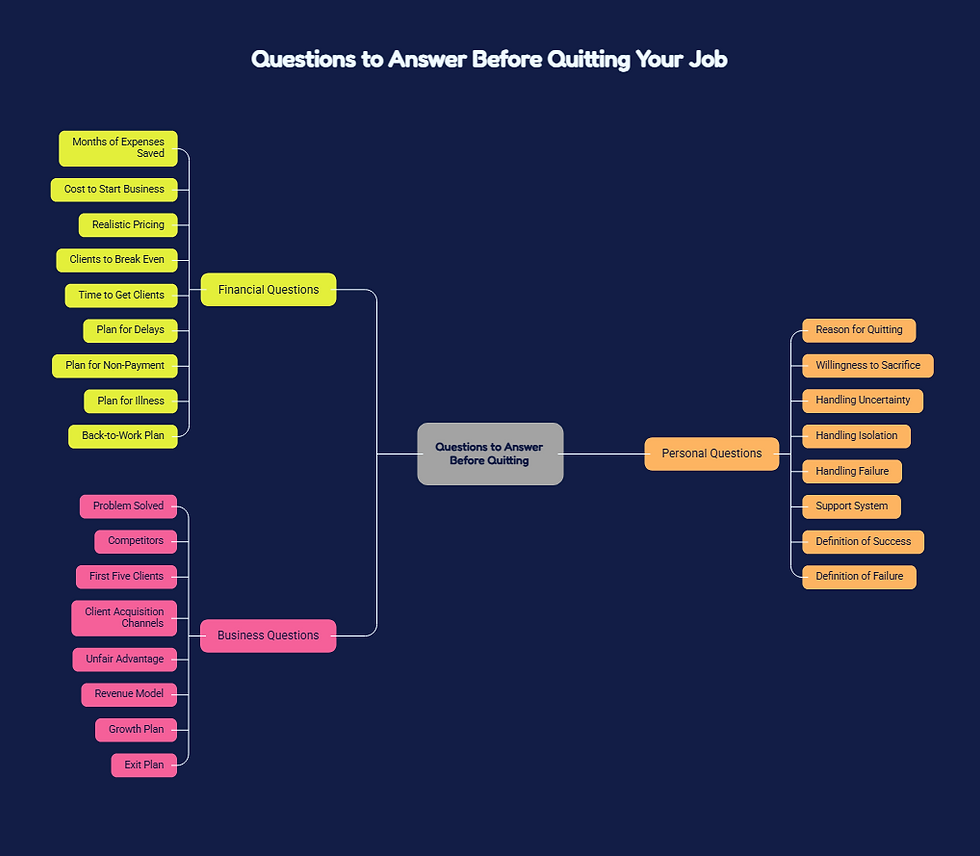
The Financial Questions
How many months of expenses do I have saved? Not in retirement accounts, not in home equity, not in "I'll figure it out." Cash in the bank.
How much will it cost to start my business? Legal, equipment, software, marketing, insurance, everything.
What will I charge, realistically? Based on market research, not hope.
How many clients do I need to break even? At those realistic rates.
How long will it take to get those clients? Based on conversations with people who've done it, not optimism.
What's my plan if it takes twice as long?
What's my plan if my biggest client doesn't pay?
What's my plan if I get sick and can't work for a month?
What's my back-to-work plan if this doesn't work out?
The Personal Questions
Why am I really doing this? What am I running toward? What am I running from?
What am I willing to sacrifice? Evenings? Weekends? Time with family? Health? Hobbies? Peace of mind?
How do I handle uncertainty? Do I thrive on it or crumble under it?
How do I handle isolation? Am I comfortable alone for days at a time?
How do I handle failure? What's my track record with setbacks?
Who will support me when things get hard? Partner, friends, family, mentor, therapist?
What's my definition of success? Not in general, but specifically. What does "making it" look like?
What's my definition of failure? At what point do I call it and go back?
The Business Questions
What problem am I solving? For whom? Why me?
Who are my competitors? What do they do well? Where do they suck?
Who are my first five clients? By name. If you don't know, you're not ready.
How will they find me? Specific channels, specific strategies, specific tactics.
What's my unfair advantage? Why will I win where others lose?
What's my revenue model? How, exactly, will money flow from their pocket to mine?
What's my growth plan? How do I go from one client to ten to a hundred?
What's my exit plan? How do I get out when I'm ready to be done?
If you can't answer these questions, you're not ready. You're in love with the idea, not the reality.
PART NINE: THE REALITY CHECK YOU NEED
Let me tell you about people who made the leap without doing this work.
The Graphic Designer
She was a marketing coordinator making $45,000. She hated her job. She was a good designer on the side. She quit to freelance, charging $50 an hour.
She didn't account for non-billable time. She didn't account for taxes. She didn't account for expenses. She didn't account for dry spells.
Eight months in, she'd made $38,000 gross, $24,000 net, and worked twice as hard as she ever had at her job. She went back to corporate, humiliated and broke.
The Consultant
He was a mid-level manager making $75,000. He had expertise. He had connections. He quit to consult at $150 an hour.
He didn't account for how hard selling is. He didn't account for how long sales cycles take. He didn't account for how much time he'd spend on proposals that went nowhere.
Eighteen months in, he'd made $60,000, spent $40,000 on expenses, and was $20,000 in debt. His marriage was strained. His confidence was shattered. He went back to a job that paid less than the one he left.
The E-commerce Entrepreneur
She had a great idea for a product. She had $30,000 in savings. She quit her job to build her dream.
She didn't account for how long development would take. She didn't account for how much marketing would cost. She didn't account for how hard customer acquisition would be.
Two years in, she'd spent $50,000, made $12,000, and was $38,000 in debt. She went back to a job she hated even more than the one she left, with less money and less hope.
These are not exceptions. These are the rule. Most entrepreneurs who quit their jobs without doing the work fail. They fail financially, emotionally, and professionally. They go back to jobs,
if they can get them, with less money, less confidence, and less hope.
You are not special (oh, but you are!). The rules do still apply to you, nonetheless.
PART TEN: THE ALTERNATIVE
I'm not here to tell you not to start a business. On the contrary, I wholeheartedly encourage you to pursue your entrepreneurial dreams. However, what I am here to emphasize is the importance of doing it right from the very beginning. Starting a business is not merely about having a great idea; it involves careful planning, strategic thinking, and a deep understanding of the market you intend to enter. To embark on this journey successfully, you need to conduct thorough market research to identify your target audience and understand their needs and preferences. This involves not only analyzing existing competitors but also recognizing gaps in the market that your business could fill. In addition, creating a solid business plan is crucial. This plan should outline your business goals, your strategies for reaching those goals, your financial projections, and the resources you will need. Furthermore, legal considerations cannot be overlooked. Registering your business, obtaining the necessary licenses and permits, and understanding the regulatory environment are all essential steps that will help you avoid potential pitfalls down the road.
Moreover, establishing a strong brand identity and marketing strategy is vital. Your brand is not just a logo; it encompasses the values and mission of your business, and it should resonate with your target audience. Effective marketing strategies will help you to reach potential customers and build a loyal customer base. Lastly, it's important to remain adaptable. The business landscape is constantly changing, and being able to pivot and adjust your strategies in response to new challenges and opportunities is key to long-term success. So, as you embark on your entrepreneurial journey, remember that while the idea of starting a business is exciting, the execution is where the true challenge lies. Approach it with careful thought and a commitment to doing it right, and you will set yourself up for a much greater chance of success.
The Alternative Path
Keep your job. For now.
Use your evenings and weekends to build. Slowly. Sustainably. Without the pressure of needing it to work immediately.
Test your idea. Get your first client while you still have a paycheck. Learn what works and what doesn't without the fear of eviction.
Build your runway. Save every dollar you can. Get to that six-month minimum, then twelve, then eighteen.
Answer every question in this article. Write down your answers. Update them as you learn.
Talk to people who've done it. Real people, not Instagram influencers. Ask them what they wish they'd known. Ask them what nearly broke them. Ask them if they'd do it again.
Start part-time. Freelance on the side. Consult on evenings and weekends. Prove that people will pay you before you bet everything on it.
Then, when you have:
A proven idea
Real clients
Enough savings
A clear plan
Realistic expectations
A fallback position
Then you quit.
Not before.
PART ELEVEN: THE SIGN YOU'RE ACTUALLY READY
How do you know you're ready? Here are the signs.
You've done the math, and it works. You've run the numbers realistically, conservatively, and they work. You know your break-even point. You know your runway. You know your worst-case scenario and you can survive it.
You have clients waiting. Not "I think I can get clients." Actual people who have said, "When you're ready, I will pay you." By name. With money amounts.
You have savings. Enough to cover your personal expenses for at least a year, plus your business startup costs, plus a buffer for emergencies.
You have a support system. People who understand what you're doing and will be there when it gets hard. Partner, friends, mentor, coach, therapist—someone.
You've done the soul-searching. You know why you're doing this. You know what you're willing to sacrifice. You know what success looks like and what failure looks like. You're in love with the reality, not just the idea.
You're not running away from something. You're running toward something. There's a difference, and it matters.
You're ready to work harder than you've ever worked. Not for a month, not for a year, but forever. You understand that there is no finish line, and you're okay with that.
You're ready to be alone. You understand that entrepreneurship is lonely, and you've made peace with it.
You're ready to fail. You know it's going to happen. You know you'll get knocked down. You know you'll have to get back up. And you know you will.
You're ready to succeed. You know what success looks like and you're ready for it. You're ready for the attention, the responsibility, the expectations. You're ready for everything to change.
If these signs are present, you're ready. If they're not, you're not.
PART TWELVE: THE FINAL WORD
The 2:47 AM feeling is real. The weight is real. The desire for something more is real.
But so is the math. So is the struggle. So is the loneliness. So is the failure rate.
Entrepreneurship is not freedom. It is a different kind of captivity, one where you are both the prisoner and the guard.
It is not autonomy. It is answering to more people than you ever did, just different people.
It is not easy. It is harder than anything you've ever done, for longer than you can imagine.
And it is also wonderful. For the right person, with the right preparation, the right mindset, the right reasons, it is the best decision they ever made.
The question is not whether entrepreneurship can be wonderful. It can.
The question is whether you are the right person, with the right preparation, the right mindset, the right reasons.
And the only way to answer that question is to do the work. The soul-searching. The money figuring. The planning. The testing. The proving.
Not at 2:47 AM, when the ceiling is your only audience and fantasy is your only companion.
But in the cold light of day, with a spreadsheet in front of you and hard questions demanding hard answers.
Do that work. Then decide.
Because once you burn the boat, there's no going back. The only way is forward, through whatever comes.
Make sure you're ready for whatever comes.
The Juxtaposed Tides Offer
We work with entrepreneurs every day. Some succeed. Some fail. The difference is almost never about talent or ideas. It's about preparation, mindset, and the willingness to face reality.
If you're ready to do this right—to plan, to prepare, to build something that actually works—we can help.
If you're still in love with the idea and not ready for the reality, we can't. No one can.
Do the work. Then call us.
Ready to have an honest conversation about your entrepreneurial future? Schedule a discovery call with Juxtaposed Tides.


Comments