
AI Impersonation Scams: Deepfake Voices, Fake Executives, and Safer Payments

JUXTAPOSED TIDES SMART SERIES
A deepfake is a computer-generated imitation of somebody's voice, face, or video. It can sound or look familiar without actually coming from that person. A surprising request for money or information should always be checked through contact details your business already trusts.

The Voice Is No Longer Proof
A convincing voice message used to feel like strong evidence. A video call with a recognizable face felt stronger. In 2026, neither should authorize money, credentials, sensitive files, or account changes by itself. Generative tools can imitate voices, faces, writing styles, logos, invoices, and executive communication patterns at low cost. The practical consequence is not that every message is fake. It is that appearance is no longer sufficient proof.
AI impersonation scams exploit the gap between what people perceive and what the business verifies. The request often uses urgency, secrecy, authority, and emotion: “I am in a meeting,” “Do not tell the client,” “We will lose the deal,” or “This must be paid before the bank closes.” The technology makes the story more believable, but the underlying attack remains social engineering.
The FTC reported that consumers lost $3.5 billion to imposter scams in 2025, and nearly one in three fraud reports involved impersonation. That does not mean every case used AI. It does show why impersonation has become a major trust problem—and why businesses need procedures that survive convincing media.
The New Rule: Authenticate the Request, Not the Person’s Appearance
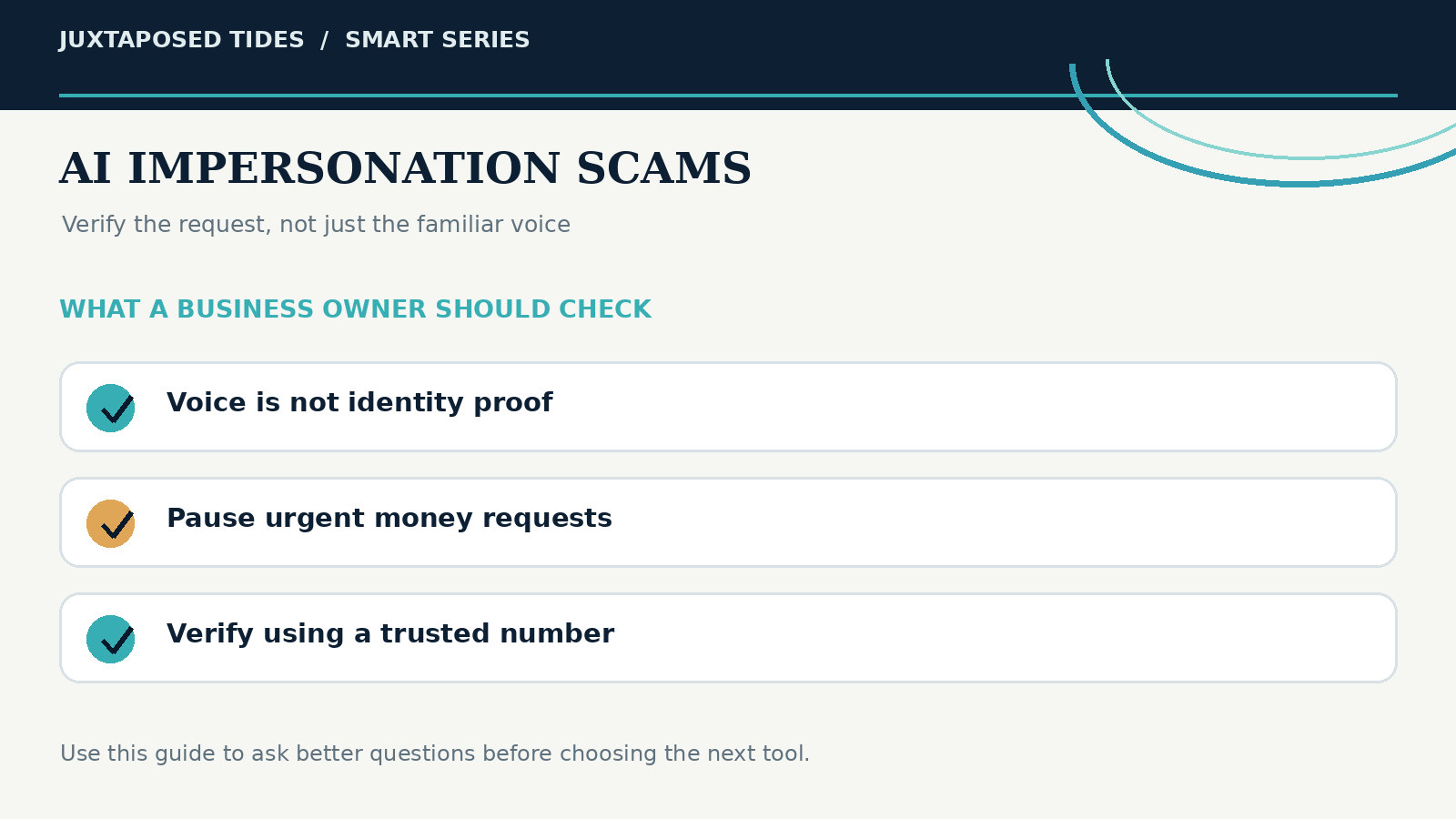
The goal is not to prove whether an audio clip is synthetic in real time. Detection tools will improve, but attackers adapt. A more durable defense is to verify the request through a separate, pre-established method that the attacker does not control.
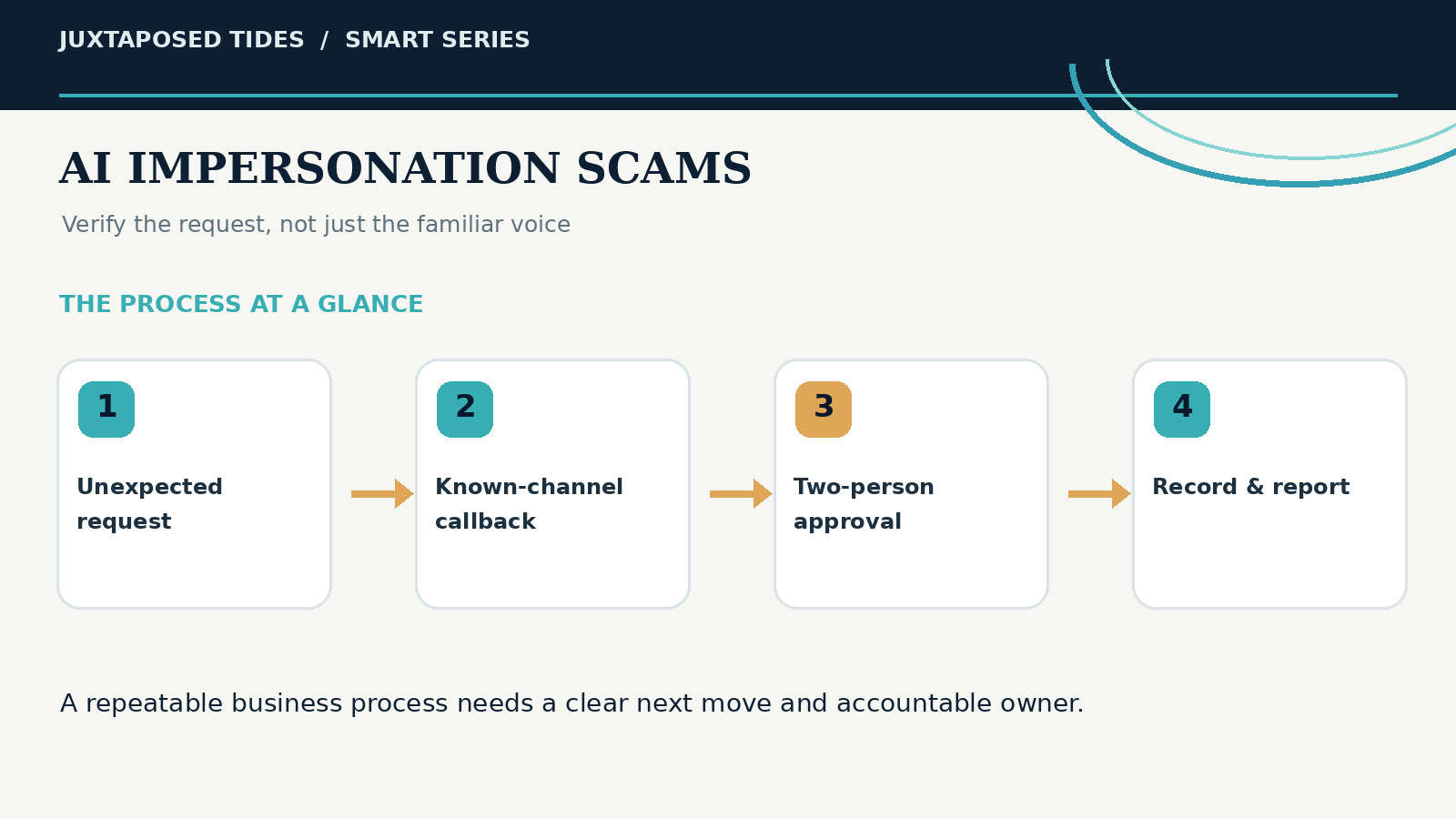
Known-Channel Callback
Call the requester using a number already stored in the company directory, contract, CRM, or prior verified record. Do not use the number provided in the message. For vendors, call a known contact and confirm both the request and any changed payment details.
Transaction-Specific Challenge
Use an internal approval code, ticket number, or workflow step that is not public and changes regularly. Avoid personal “secret questions” that can be learned from social media. The challenge should confirm the transaction—not merely the person’s biography.
A visual guide to the key stages and responsibilities discussed in this article.
Dual Approval
Require two authorized people for wires, new payees, bank-detail changes, payroll changes, large refunds, gift cards, cryptocurrency, and sensitive data exports. The second person should review the source documents and verify through a separate channel.
Delay for High-Risk Changes
Build a cooling-off period for new bank accounts or unusual payment routes. A legitimate vendor can tolerate a documented verification step. A scammer depends on speed. Trust design principle: No voice, face, email, text, or chat message should be able to move high-risk value alone—no matter how convincing it appears.
Where AI Impersonation Scams Hit Small Businesses
Owner and Executive Impersonation
An attacker poses as the owner and requests a wire, gift cards, credentials, or sensitive documents. Small teams are vulnerable because one person may control both authority and payment. Create rules that apply to owners too. Leadership must publicly authorize staff to verify and delay.
Vendor and Invoice Impersonation
Attackers monitor public projects, compromised inboxes, or social media to identify vendors and payment timing. They send a new invoice or claim bank details changed. Require bank changes to be confirmed using existing vendor records and documented in a controlled system.
Customer Support and Account Recovery
A fraudster may imitate a customer to reset credentials, redirect a refund, obtain private records, or take over an account. Support teams need defined identity checks, escalation rules, and limits on what can be changed through chat or email.
Recruiting and Contractor Fraud
Fake candidates, fake recruiters, and synthetic profiles may seek access to systems, code, customer data, or equipment. Verify identity, references, tax and payment information, and device access before granting broad permissions. Restrict new users to the minimum systems required.
Brand Impersonation
Criminals can clone a company’s website, ads, social profiles, support numbers, or promotions. Protect the domain, monitor lookalike domains and social profiles, publish clear payment and support channels, and make it easy for customers to verify official communication.
Build a Payment Approval Matrix
A payment approval matrix turns vague caution into a repeatable rule. Define: Which payment types require one approval, two approvals, or owner review Dollar thresholds Who may create a vendor and who may approve payment How bank-detail changes are verified Which channels are valid for urgent requests How exceptions are documented What happens when an approver is unavailable Separate the ability to enter a payee from the ability to release funds whenever practical. Turn on transaction alerts. Review new beneficiaries and unusual destinations. Do not let “the owner told me” bypass the system.
Create an Internal Verification Protocol
A good protocol should be simple enough to use under pressure. For example: Pause when a request involves urgency, secrecy, money, credentials, sensitive data, or changed instructions. Move to a known channel from the company directory. Confirm the exact transaction, amount, destination, and reason. Apply the required approval level. Document the verification in the payment, CRM, or ticketing system. Report suspicious attempts so others can be warned.
Practice this protocol with realistic drills. A quarterly five-minute simulation is more useful than a yearly lecture. Include remote staff and contractors.
A practical review of the decisions and safeguards that make this process dependable.
Do Not Overshare the Material Attackers Need
Public content can reveal executive voices, travel schedules, reporting structures, vendor relationships, project names, and payment timing. The answer is not to disappear online. It is to avoid publishing unnecessary operational details and to assume public media can be reused. Review who can post from official accounts and how executives communicate urgent requests.
AI can also copy the tone of public articles and social posts. That reinforces the guidance in Why AI Cannot Build Your Dream Site: generated resemblance is not understanding or authority.
Responding to an Impersonation Attempt
If money has not moved, preserve the message, headers, phone number, audio, video, account name, URL, and timestamps. Notify staff and the impersonated person through a verified channel. Reset credentials if an account may be compromised. Report fraudulent domains or profiles to the relevant provider.
If money moved, contact the financial institution immediately, request a recall or fraud hold, and report the incident to the FBI’s Internet Crime Complaint Center. Do not wait for a complete internal investigation before contacting the bank. Time is critical.
If customers were targeted using your brand, publish a calm verification notice through official channels. State what happened, how legitimate communication works, and what customers should do. Avoid speculation.
The Trust Stack Beats the Deepfake
Businesses will not win by teaching every employee to identify every synthetic artifact. They will win by making synthetic artifacts insufficient. Known-channel verification, transaction-specific challenges, dual approval, controlled payment changes, limited access, and rapid reporting turn an advanced deepfake into an unverified request.
The appearance of authority is cheap now. The process of authority must become strong.
Further Reading and Original Research
These independent resources are provided so you can explore the evidence and check important recommendations for yourself.
Continue With Juxtaposed Tides


Comments